
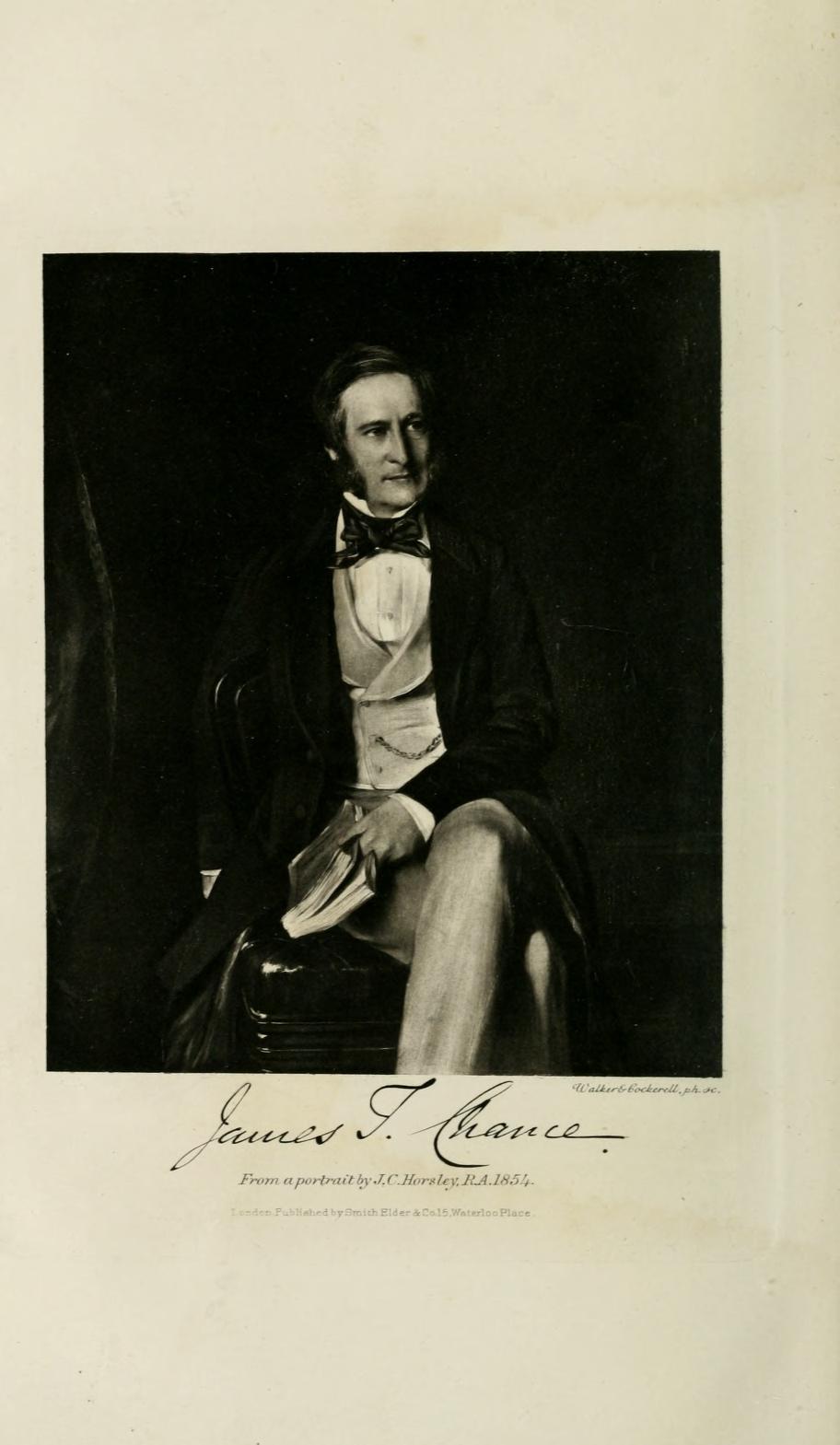
Sir James Timmins Chance, from a portrait by John Callcott Horsley, R.A., showing Chance in early middle age.
Image credit: Photograph: John Callcott Horsley, R.A. (1817–1903) · Source: Wikimedia Commons · Public Domain
James Timmins Chance – A Complete Biography
Sir James Timmins Chance was one of the most important figures in the industrial history of Smethwick.
For half a century he was associated with Chance Brothers, the glassmaking company whose works at Spon Lane grew into an internationally important industrial enterprise. Yet his significance extended far beyond the factory gates.
Chance was a mathematician, engineer, specialist in lighthouse optics, businessman, railway director, public figure and philanthropist. His work helped transform the manufacture of optical glass and lighthouse equipment, while the company with which he spent most of his working life became one of the names most closely associated with Victorian Smethwick.
His legacy can still be found locally. The former Chance Brothers site survives beside the canals at Spon Lane, while West Smethwick Park, which he gave to the public in 1895, remains one of the most visible reminders of his relationship with the town.
Early life and the Chance family
James Timmins Chance was born on 22 March 1814, the eldest son of William Chance and Phoebe Timmins. His father was a Birmingham merchant who subsequently became closely involved with the family’s glassmaking enterprise.
The Chance family’s connection with glassmaking in Smethwick had begun before James entered the business.
Robert Lucas Chance, usually known as Lucas Chance and James’s uncle, acquired the British Crown Glass Company’s works at Spon Lane. The enterprise developed into Chance Brothers, with James’s father William providing crucial financial support during its early difficulties.
James therefore grew up within a family increasingly connected with one of the industries that would transform Smethwick.
But a career in glassmaking was not initially his obvious destination.
An exceptional education
From an early age, James displayed considerable academic ability.
After private schooling at Totteridge, he studied at what became University College London, distinguishing himself in subjects including languages, mathematics and science.
His interests were unusually broad. Mathematics and natural science were accompanied by classical and linguistic studies, and for a period he considered entering the Church.
In 1833 he entered Trinity College, Cambridge.
Mathematics became his principal subject and he obtained a foundation scholarship. When he graduated Bachelor of Arts in 1838, he was ranked Seventh Wrangler in the Mathematical Tripos — a significant achievement in one of the most demanding academic examinations of Victorian Britain.
He subsequently received his MA from Cambridge in 1841.
His career could easily have followed a very different path.
Chance had considered holy orders and also entered Lincoln’s Inn with the intention of studying law. Instead, circumstances drew him towards the family glass business.
That decision would ultimately connect Smethwick with lighthouse engineering around the world.
Joining Chance Brothers
James joined the Spon Lane glassworks after leaving Cambridge and became a full partner in Chance Brothers on 1 January 1839.
He entered the company at an important moment.
British glass manufacturers faced considerable technical challenges, and Chance Brothers was actively introducing and improving European manufacturing methods.
James’s combination of mathematical knowledge and practical engineering ability proved exceptionally valuable.
Historic England records that after joining the partnership he was responsible for solving the difficult problem of grinding and polishing sheet glass to achieve a transparency previously associated with plate glass.
This was an early indication of what would characterise much of his career: applying scientific and mathematical knowledge to practical manufacturing problems.
Science inside the glassworks
Victorian industry is sometimes imagined simply as furnaces, steam engines and manual labour.
Chance Brothers demonstrates how misleading that picture can be.
Glassmaking increasingly demanded expertise in chemistry, physics, engineering and precision manufacturing.
Under figures such as James Chance, the Smethwick works became a place where scientific understanding and industrial production were closely connected.
The company developed processes for specialist glass and established facilities for optical and dioptric glass. By the middle of the nineteenth century Chance Brothers was becoming much more than a conventional window-glass manufacturer.
Its products would eventually be associated with some of the most ambitious engineering projects of the Victorian age.
The Crystal Palace
One of the firm’s most famous achievements came with the Great Exhibition of 1851.
Chance Brothers supplied the enormous quantity of sheet glass required for Joseph Paxton’s Crystal Palace in Hyde Park.
The Science Museum Group identifies the glazing of the Crystal Palace in 1850–51 as one of the major milestones in the company’s development.
For Smethwick, the significance is considerable.
Glass manufactured by a company based beside the canals at Spon Lane formed part of one of the defining structures of Victorian Britain.
But James Chance’s most important personal contribution was developing in another direction.
Turning towards the sea
During the nineteenth century, improving lighthouse illumination was a matter of life and death.
Expanding international trade meant increasing numbers of vessels navigating coastlines and dangerous waters. Reliable lighthouse beams could help mariners identify their position and distinguish one lighthouse from another.
The development of the Fresnel lens, named after French physicist Augustin-Jean Fresnel, had transformed the possibilities of lighthouse illumination.
Instead of relying upon a conventional thick lens, carefully arranged concentric sections could control and concentrate light much more efficiently.
But designing such an optical system was only part of the problem.
Manufacturing it accurately was extraordinarily difficult.
This was where James Timmins Chance and the Smethwick glassworks became internationally important.
James Chance and lighthouse optics
From 1851, Chance Brothers developed into a major manufacturer of lighthouse optical equipment.
James Chance became the driving intellectual force behind this work.
Producing a lighthouse optic demanded extraordinary precision. Large pieces of optical glass had to be manufactured, ground and arranged so that light would be refracted in exactly the required direction.
Chance applied his knowledge of mathematics, optics and engineering to improving both the manufacture and arrangement of these systems.
The company’s lighthouse work eventually encompassed optical components, mechanical equipment and other specialist apparatus.
Lighthouses thousands of miles from Smethwick would consequently contain technology manufactured at Spon Lane.
Precision on a remarkable scale
James Chance insisted upon extremely high standards.
A lighthouse optic could not simply look correct. Its individual elements had to interact with great precision.
An illuminating example occurred with equipment supplied for Whitby Lighthouse.
According to the historical account preserved by Revolutionary Players, lenses that had left the Smethwick works correctly adjusted produced a faulty beam after being reassembled at Whitby. Chance personally supervised the correction.
Thereafter, the company placed great importance on its own specialists overseeing the installation of its equipment.
Complete systems could be assembled and inspected at Smethwick, dismantled for transport and then reconstructed at their destination.
It illustrates the extraordinary reach of the operation: precision engineering carried out in an inland Black Country town was being shipped to coastlines around the world.
Recognition as an engineer
Chance was not merely a businessman supervising engineers.
He became a recognised authority in his own right.
On 7 May 1867, he presented a paper on “Optical Apparatus used in Lighthouses” to the Institution of Civil Engineers. The work earned him a Telford Medal and premium, and later that month he became an associate of the Institution.
In 1879 he returned to the subject with another paper concerning dioptric lighthouse apparatus for electric light.
His work therefore occupied the meeting point between theoretical science and practical engineering.
That is an important part of his story.
James Timmins Chance should not be remembered simply as the wealthy owner of a successful Smethwick factory. He made substantial technical contributions to the field in which the company became internationally renowned.
A worldwide Smethwick industry
Chance Brothers’ lighthouse work developed into one of the most remarkable chapters in Sandwell’s industrial history.
The company’s equipment travelled far beyond Britain.
Its expertise in optical glass and lighthouse apparatus established a reputation that outlived James himself.
For generations of workers in Smethwick, this international industry was nevertheless intensely local.
The furnaces, workshops, canals and buildings were part of their everyday landscape.
This contrast is one of the most fascinating aspects of Chance Brothers: a factory rooted firmly in Smethwick produced highly specialised equipment intended for some of the most remote coastlines in the world.
Fifty years with Chance Brothers
James remained a partner in Chance Brothers for fifty years.
He gradually withdrew from direct management during the later nineteenth century. In 1872 responsibility for the lighthouse department passed to the distinguished engineer and physicist John Hopkinson, whose services the company had secured.
James ultimately retired from the partnership in 1889, when the business was incorporated as Chance Brothers & Co. Ltd.
By then the company he had joined as a young Cambridge graduate had become one of Britain’s notable specialist manufacturers.
Public life
Chance’s activities extended beyond business and engineering.
He became involved in local and county affairs and held several public positions.
He served as a Justice of the Peace, became a Deputy Lieutenant, and was High Sheriff of Staffordshire in 1868.
He was also associated with the Volunteer movement and played an important role in establishing the Handsworth Volunteer Rifle Corps.
For many years he served as a director of the London and North Western Railway, another connection with one of Victorian Britain’s great industries.
His interests also extended strongly into education and philanthropy.
Education and philanthropy
Chance’s own education had clearly shaped his outlook.
He supported educational institutions and became involved with organisations in Birmingham as well as Smethwick.
One of his most substantial later benefactions was connected with the emerging University of Birmingham. Contemporary biographical material records a major donation associated with engineering education, while later accounts record a £50,000 contribution to the university’s endowment in 1900.
For a man whose own industrial career had depended so heavily upon mathematics, science and engineering, support for technical education was an appropriate legacy.
But in Smethwick, one gift remains more visible than any other.
The creation of West Smethwick Park
In 1895, James Timmins Chance gave West Smethwick Park to the public.
He purchased the land, arranged for the park to be laid out and provided an endowment for it. Contemporary biographical material valued the gift and endowment at approximately £30,000.
The park opened on 7 September 1895.
This was not simply the donation of an ornamental space.
Public parks were increasingly regarded as important amenities in heavily industrialised Victorian towns. They provided recreation, greenery and open space for communities living amid factories, smoke and dense housing.
For generations of Smethwick residents who followed, West Smethwick Park became part of everyday life.
Children played there. Families walked around its lake. Sporting and community activities took place there.
More than 130 years later, the park remains public.
Few legacies could connect James Chance more directly with modern Smethwick.
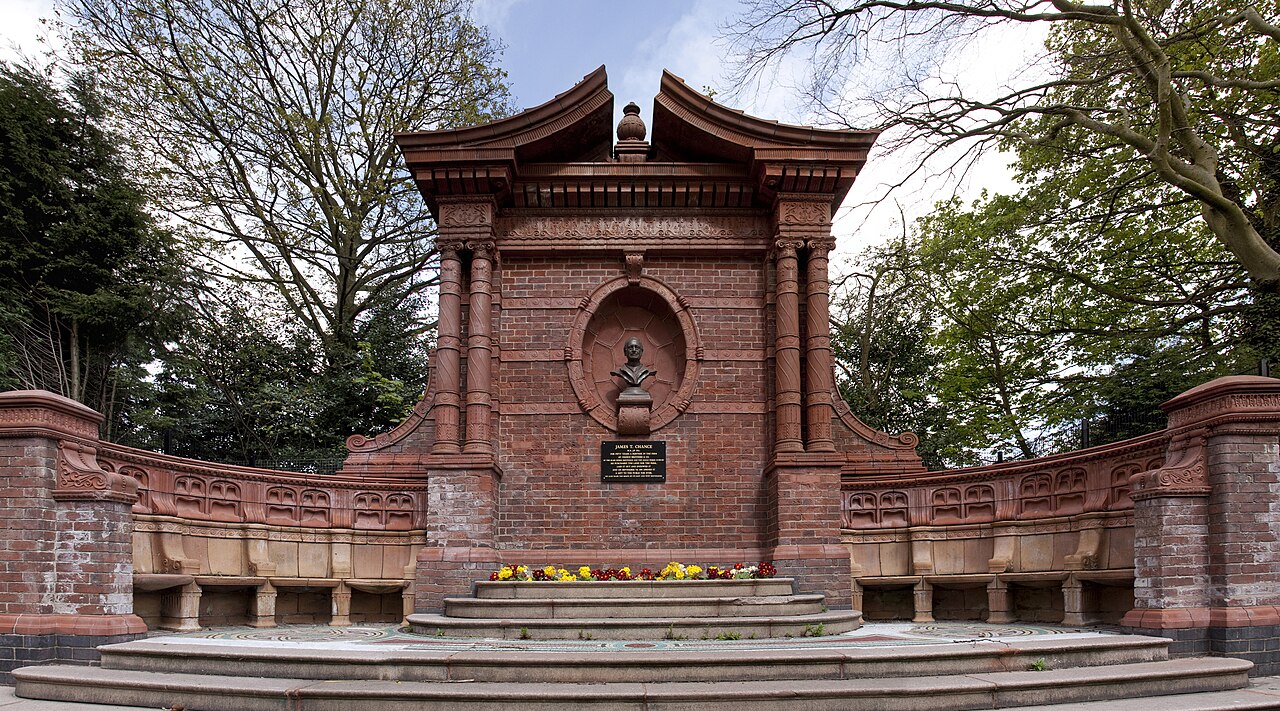
The memorial to James Timmins Chance in West Smethwick Park.
Image credit: Photograph: Tony Hisgett · Source: Wikimedia Commons · CC BY 2.0 · Image date: 30 April 2010
The James Chance Memorial
Within West Smethwick Park stands the memorial to James Chance that you have photographed.
Its brick and terracotta structure incorporates a bronze portrait bust by the celebrated sculptor Hamo Thornycroft.
The memorial deliberately records Chance’s connection with both the glassworks and the creation of the park.
For your website, this is particularly valuable because it turns an apparently decorative park monument into a gateway to a much larger story.
Behind the face depicted on the memorial lies the history of Victorian science, glassmaking, international lighthouse engineering and one of Smethwick’s most important industrial families.
A baronetcy
Near the end of his life, James received national recognition.
In 1900, Queen Victoria created him a baronet, making him Sir James Timmins Chance, 1st Baronet.
The honour came after a career spanning industry, engineering, public service and philanthropy.
His eldest son, William, subsequently inherited the title as Sir William Chance, 2nd Baronet.
Final years and death
By this period James was no longer managing the industrial enterprise that had dominated his working life.
He spent his later years at Hove in Sussex.
Sir James Timmins Chance died there on 6 January 1902, aged 87.
His death came only two years after receiving his baronetcy and seven years after the opening of West Smethwick Park.
The company, however, continued.
So did the park.
And so did the lighthouse equipment carrying the Chance name around the world.
His portrait
James Chance was portrayed during his lifetime by John Callcott Horsley in 1851.
Another portrait, by Joseph Gibbs, was presented to Smethwick Borough Council in December 1902, following Chance’s death. That portrait is now associated with the collections of Wednesbury Museum and Art Gallery.
[KEEP YOUR EXISTING PORTRAIT NEAR THIS SECTION]
The portraits are useful historical records, but perhaps the more revealing monuments to Chance are not portraits at all.
They are the surviving industrial landscape at Spon Lane and the public park at West Smethwick.
The surviving Chance Brothers site
The former Chance Brothers works remains one of Smethwick’s most important industrial heritage sites.
Historic England describes the archaeological remains of the North Works as nationally significant and records eight listed buildings within the glassworks site.
Its location is itself part of the story.
The works developed between major lines of the Birmingham Canal Navigations, placing it within the transport network that helped industrial Smethwick grow.
Today, the surviving buildings provide a physical connection with the company James joined in 1838 and helped develop over the following half-century.
Why James Timmins Chance matters to Smethwick
James Chance’s importance is difficult to reduce to a single achievement.
He helped advance glass manufacturing.
He became an authority on lighthouse optics.
He helped Chance Brothers achieve an international reputation.
He participated in public life.
He supported education.
And he gave Smethwick a park that remains in public use today.
His career also demonstrates something much larger about the history of the town.
Victorian Smethwick was not simply a place where things were manufactured cheaply and in enormous quantities.
It could also be a centre of science, experimentation, precision engineering and technological innovation.
Ideas developed beside the canals of Smethwick could influence lighthouse technology used far beyond Britain.
That makes James Timmins Chance not merely a notable local industrialist, but an important figure in the wider history of Victorian engineering.
A legacy still visible
More than a century after his death, the landscape still tells his story.
The remains of Chance Brothers stand at Spon Lane.
West Smethwick Park continues to provide the public open space he intended.
His memorial still overlooks the park.
And around the world, historic lighthouse equipment preserves the name of the company whose optical engineering he did so much to develop.
For Smethwick, Sir James Timmins Chance represents an extraordinary connection between the local and the international.
His working life was rooted in a glassworks beside the Birmingham canals.
Its influence reached coastlines around the world.
And his most enduring personal gift remained at home.
Sources & Further Reading
Historic England — Chance’s Glassworks, Smethwick
Science Museum Group — Chance Brothers Limited
Dictionary of National Biography — Sir James Timmins Chance
Revolutionary Players — Sir James Timmins Chance: Engineer
Revolutionary Players — Lighthouse Production