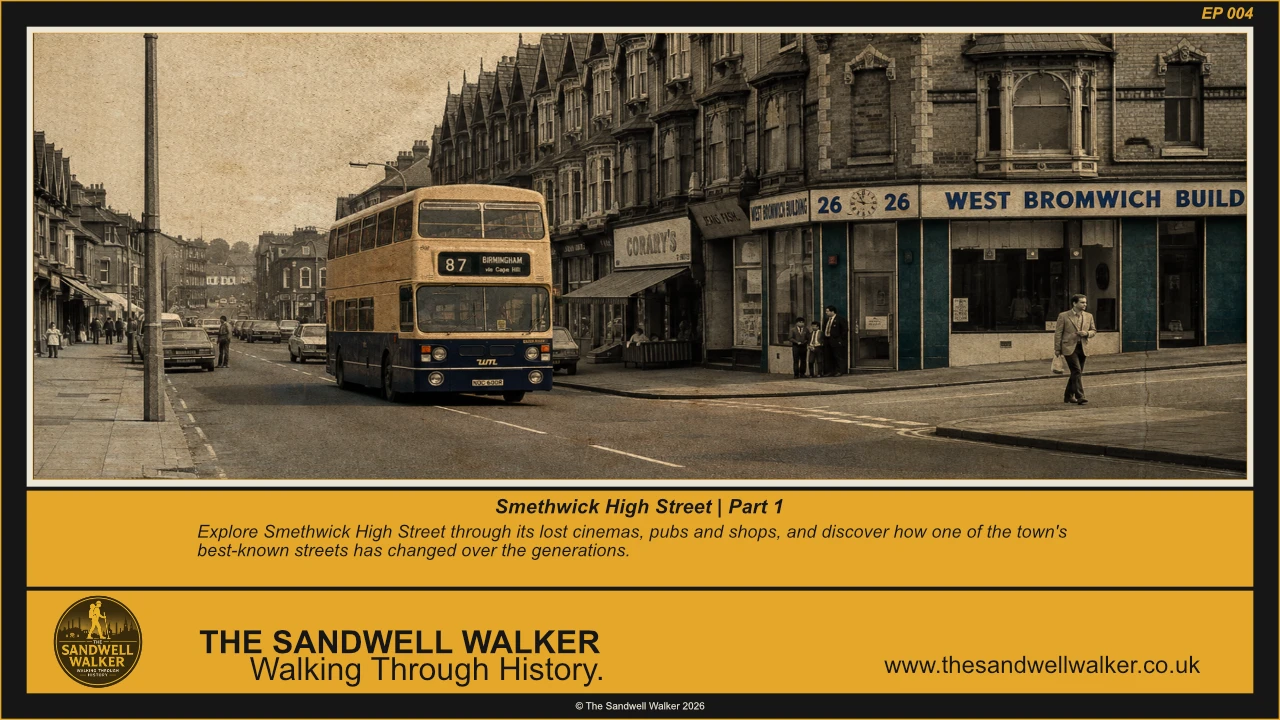
Smethwick High Street has been at the heart of the town for generations, but the street we see today is very different from the one remembered by earlier residents.
In Part 1 of this journey along Smethwick High Street, I begin around the St Paul’s Road end and make my way towards Coopers Lane, looking for the buildings, businesses and landmarks that once made this one of Smethwick’s busiest streets.
A High Street Built Around Everyday Life
For generations, High Street was much more than a route through Smethwick. It was somewhere people came to shop, meet friends, visit the cinema, have a drink and go about everyday life.
Rows of independent businesses once lined the street, while cinemas and public houses became familiar landmarks for generations of local people.
Many have now disappeared, changed use or been replaced entirely.
The Empire Theatre
One of the important entertainment venues explored in the episode is the former Empire Theatre, situated around the St Paul’s Road/St Alban’s Road end of the area.
The building survived long after its days as an entertainment venue and subsequently became associated with Gurdwara Baba Sang Ji.
Its changing use provides a particularly interesting example of how buildings along and around High Street have adapted as Smethwick itself has changed.
The Prince’s Cinema
Further along was another important cinema: the Prince’s Cinema at 128–130 High Street.
The Prince’s was separate from the Empire and became part of Smethwick’s long history of cinema-going. In later years the building was also associated with Bollywood film exhibition, reflecting the changing population and culture of the town.
The former cinema was eventually demolished in 2008, removing another recognisable piece of the old High Street.
Pubs and Meeting Places
High Street was also home to numerous pubs and social meeting places.
Among the landmarks encountered during this part of the walk are the North Western Hotel and the Blue Gates, reminders of a period when public houses were a prominent part of everyday High Street life.
Like the shops and cinemas, these places were more than simply buildings. They became reference points around which people’s memories of the town developed.
The Changing Shops of High Street
Perhaps the greatest transformation is visible in the shops themselves.
Businesses have opened, closed and changed hands repeatedly over the decades. Shopfronts have been altered, buildings have disappeared and the communities using High Street have changed.
Yet beneath those alterations, parts of the older street can still be recognised.
Looking carefully at surviving buildings — and comparing them with historic photographs and records — reveals traces of the High Street experienced by previous generations.
Holy Trinity and the Wider High Street
The journey also considers landmarks such as Holy Trinity, helping place the commercial history of High Street within the wider development of Smethwick.
Together, these surviving buildings and vanished businesses tell a much larger story: not simply how a shopping street changed, but how Smethwick itself changed around it.
Watch the Full Story
In Smethwick High Street: The Lost Cinemas, Pubs & Shops | Part 1, we walk the street as it exists today while uncovering some of the places that once stood here.
And this is only the first part of the journey. Part 2 continues further along High Street, uncovering more of the buildings and stories associated with this historic route.
Do You Remember Smethwick High Street?
If you remember shopping on High Street, visiting one of its cinemas or pubs, or remember businesses that have since disappeared, I’d particularly like to hear from you.
Old photographs, shop names and personal memories can all help preserve details of Smethwick’s history that might otherwise be lost.