Few places illustrate the transformation of the Black Country as dramatically as Tipton.
The modern town grew from a collection of much older settlements scattered across a landscape that once looked very different. Beneath that landscape, however, lay the resources that would eventually transform Tipton into one of Britain’s most intensely industrialised districts.
Coal, ironstone and clay encouraged mining and manufacturing. Canals crossed the landscape. Furnaces, foundries and factories appeared alongside them.
By the nineteenth century, Tipton had become a place where industry was almost impossible to escape.
Then, during the twentieth century, the landscape changed again.
Collieries closed, furnaces disappeared and huge areas of damaged industrial land were reclaimed for housing, roads, parks and new development.
Modern Tipton was built partly on top of its industrial past.
An old Black Country settlement
Tipton’s history long predates the Industrial Revolution.
The place appears in the Domesday Book of 1086, when it was recorded as Tibintone. The name is generally understood to have Anglo-Saxon origins.
For centuries the area remained predominantly agricultural.
Rather than one compact town, settlements developed at places including Tipton Green, Ocker Hill, Princes End, Great Bridge and Dudley Port.
Tracks and roads linked farms, cottages and small communities.
But underneath this rural landscape lay extensive mineral deposits.
Those resources would eventually determine Tipton’s future.
Coal beneath the town
Tipton lay within the South Staffordshire Coalfield.
The famous Thick Coal seam beneath parts of the Black Country could reach around 30 feet in thickness, making it an extraordinarily valuable source of fuel.
Coal extraction had taken place locally long before the Industrial Revolution, initially where seams were relatively close to the surface.
As demand increased, mining expanded.
Steam-powered pumping eventually made deeper workings possible, allowing collieries to exploit deposits that earlier miners could not reach.
By the nineteenth century, pits had spread across Tipton.
Coal provided domestic fuel, powered steam engines and supplied the furnaces and factories multiplying across the Black Country.
Mining became one of the foundations of Tipton’s economy.
Iron transforms Tipton
Coal alone did not create industrial Tipton.
Ironstone was also available locally.
The combination of coal and iron ore in the same district encouraged iron production on a huge scale.
Furnaces, forges and foundries appeared across Tipton and neighbouring communities.
Among the names associated with Tipton’s industrial history was the Tipton Green Ironworks, while numerous smaller firms manufactured metal products ranging from chains and nails to engineering components.
Industry attracted workers.
Workers needed housing.
Streets and communities grew around pits and factories.
Within a relatively short period, the rural landscape was transformed.
The canal revolution
Tipton’s location within the Birmingham Canal Navigations became another defining feature of the town.
The earliest Birmingham Canal route through the area opened during the eighteenth century, connecting the Black Country’s mineral resources with Birmingham.
Canals were ideal for heavy industry.
A horse could move far more coal or iron by towing a boat than it could haul by road.
As industry expanded, branches and basins were constructed to serve individual collieries and works.
The result was extraordinary.
Tipton became surrounded and crossed by waterways.
The dense canal network contributed to Tipton sometimes being associated with the nickname “Venice of the Midlands.”
Canals were not picturesque leisure routes in those days.
They were industrial transport corridors crowded with working boats carrying coal, iron and manufactured goods.
Telford changes the canals
By the early nineteenth century, parts of the original canal network were struggling with increasing traffic.
Engineer Thomas Telford was commissioned to improve the Birmingham Canal system.
His new Main Line provided a straighter and more efficient route, cutting through the Black Country landscape while older sections remained in use.
At Tipton, the relationship between the old and new canal routes created one of the most fascinating surviving pieces of Black Country industrial infrastructure.
The canals still provide some of the clearest physical evidence of Tipton’s industrial past.
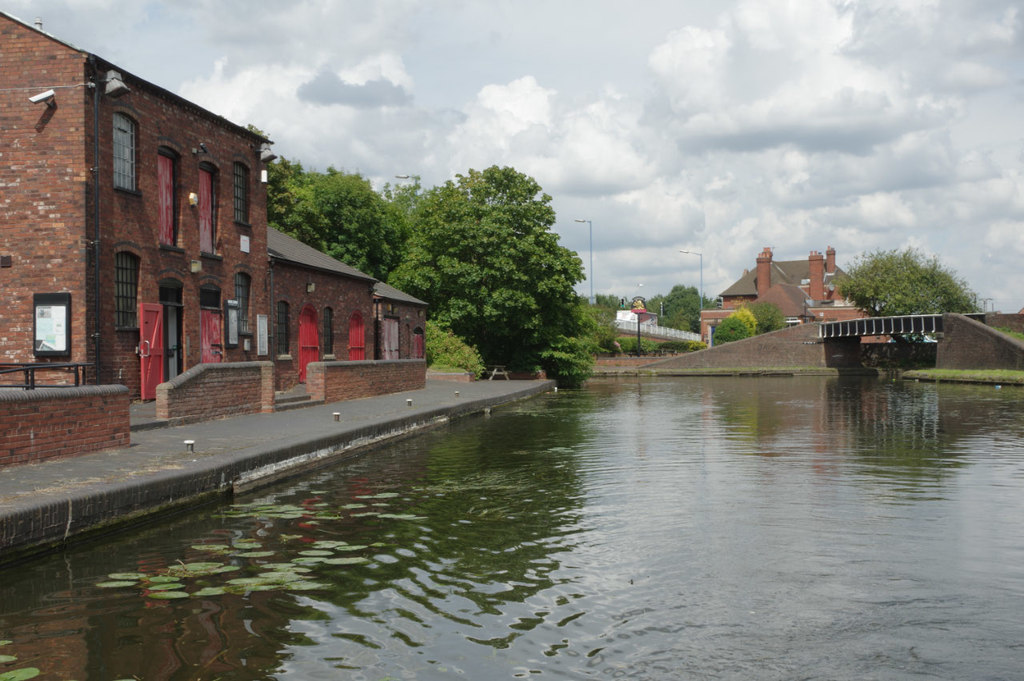
Factory Junction in Tipton, where the Birmingham Old Main Line meets Telford's New Main Line — a surviving reminder of the canal network that served the Black Country's industries.
Image credit: Photograph: Stephen McKay · Source: Geograph Britain and Ireland · CC BY-SA 2.0 · Image date: 8 August 2014
Railways arrive
Railways added another transport revolution.
The Stour Valley railway opened through the area during the nineteenth century, while other lines served the factories, collieries and communities around Tipton.
Dudley Port became particularly important as a railway location.
Railways allowed goods and passengers to travel far more rapidly than canal boats.
Yet canals did not immediately disappear.
For decades the two systems worked alongside each other, creating a landscape where railway bridges, canal aqueducts, roads and factory sidings crossed one another.
Tipton’s industrial communities
Industrial Tipton was not simply a collection of factories.
Distinct communities developed around employment and transport.
Great Bridge became an important commercial and industrial centre.
Princes End developed around mining and manufacturing.
Ocker Hill grew alongside collieries and industry.
Dudley Port became closely associated with transport and manufacturing.
Tipton Green developed as another important focus.
These neighbourhood identities remain important today.
Understanding Tipton therefore means recognising that the modern town developed from several interconnected industrial communities, rather than from one single historic centre.
Victorian Tipton
Rapid industrial growth created enormous challenges.
Housing was often constructed quickly close to workplaces.
Pollution from furnaces, factories and domestic fires affected air quality.
Mining caused subsidence.
Watercourses and canals received industrial waste.
Public health became a serious concern.
Gradually, local authorities introduced improvements to sanitation, water supply, roads and housing.
Schools, churches and public buildings appeared as Tipton developed the institutions expected of a substantial Victorian industrial district.
The Bean family and engineering
Tipton later became associated with another important industry: motor vehicles.
A. Harper, Sons & Bean developed from an engineering business into a major motor manufacturer.
After the First World War, Bean Cars were produced at factories in the Tipton and Dudley area.
For a period, Bean became one of Britain’s significant car manufacturers.
The company also became associated with an extraordinary achievement when explorer Francis Birtles drove a Bean car from England to Australia in 1927–28.
Although car production did not ultimately survive, the Bean name remains an important part of Tipton’s engineering heritage.
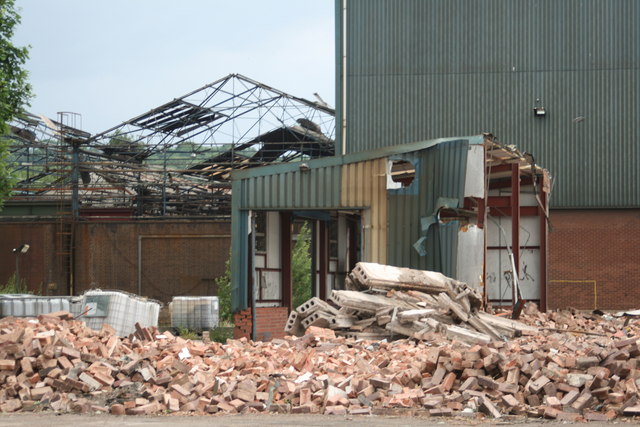
Bean's Foundry in Tipton during demolition in July 2008, recording the disappearance of part of the town's historic industrial landscape.
Image credit: Photograph: Paul Hunt · Source: Geograph Britain and Ireland / Wikimedia Commons · CC BY-SA 2.0 · Image date: 1 July 2008
Industry begins to disappear
By the twentieth century, the industries that created Tipton were beginning to change.
Coal reserves became increasingly difficult or uneconomic to exploit.
Collieries closed.
Older ironworks and factories disappeared or were replaced by newer forms of manufacturing.
The enormous environmental legacy of industrialisation remained.
Tipton contained spoil heaps, abandoned pits, contaminated industrial land and areas affected by mining subsidence.
The landscape that had produced enormous wealth now presented an equally enormous reclamation problem.
Reclaiming Tipton
Post-war redevelopment transformed the town.
Old housing was demolished.
Former industrial sites were cleared.
Mine workings were stabilised.
New housing estates appeared.
Roads were constructed across areas once occupied by pits and factories.
Land that had been almost unusable was reclaimed.
This process dramatically changed Tipton’s appearance.
Someone returning after several decades could find entire industrial landscapes missing.
In some places, only canals, railway structures, street names or fragments of buildings revealed what had once occupied the land.
Local government changes
Tipton had developed its own strong municipal identity.
In 1938, Tipton became a Municipal Borough.
That independence ended during the major local-government changes of the 1960s.
In 1966, most of the borough became part of the expanded County Borough of West Bromwich, while some areas were transferred to Dudley.
Further reorganisation followed in 1974, when West Bromwich and Warley were combined to create the Metropolitan Borough of Sandwell.
Tipton became one of Sandwell’s six principal towns.
Its community identity, however, remained distinct.
Tipton today
Modern Tipton can look surprisingly green compared with descriptions of its industrial past.
That contrast is one of the most interesting things about the town.
Places once occupied by mines, furnaces and spoil heaps have become housing estates, open spaces, roads and commercial developments.
Yet the industrial landscape has not vanished completely.
The canals remain particularly important.
Bridges and railway structures survive.
Historic buildings appear between later developments.
Street and place names preserve memories of vanished works and collieries.
And beneath modern Tipton lie extensive remains of the mining landscape that shaped generations of local lives.
Tipton’s history is therefore a story of two enormous transformations.
The first changed a rural Staffordshire landscape into one of the most heavily industrialised parts of Britain.
The second dismantled much of that industrial landscape and created the modern town.
Understanding Tipton today means looking for evidence of both.