Wednesbury has a claim to being one of the oldest documented settlements in what is now Sandwell.
Long before the factories and furnaces of the Black Country, people were living and working around the prominent hill on which the historic settlement developed.
Its location was important. The elevated ground provided a defensible position, while routes crossing the nearby River Tame connected the settlement with neighbouring communities.
Sandwell’s historic research identifies Wednesbury as the earliest documented settlement within the modern borough, and records its early development as a fortified settlement associated with defence against Viking incursions.
An ancient settlement
The historic focus of Wednesbury developed around Church Hill, close to the site of St Bartholomew’s Church and an early manor house.
Although the present church has been substantially reconstructed, Sandwell’s archaeological research indicates that both a church and manor house were established here by at least the thirteenth century.
Transport routes helped the settlement grow.
A bridge at Finchpath carried the Birmingham–Wolverhampton road across the River Tame by 1225, while another crossing connected Wednesbury towards West Bromwich. A route towards Walsall was established by the mid-fourteenth century.
These routes converged close to what became the Market Place.
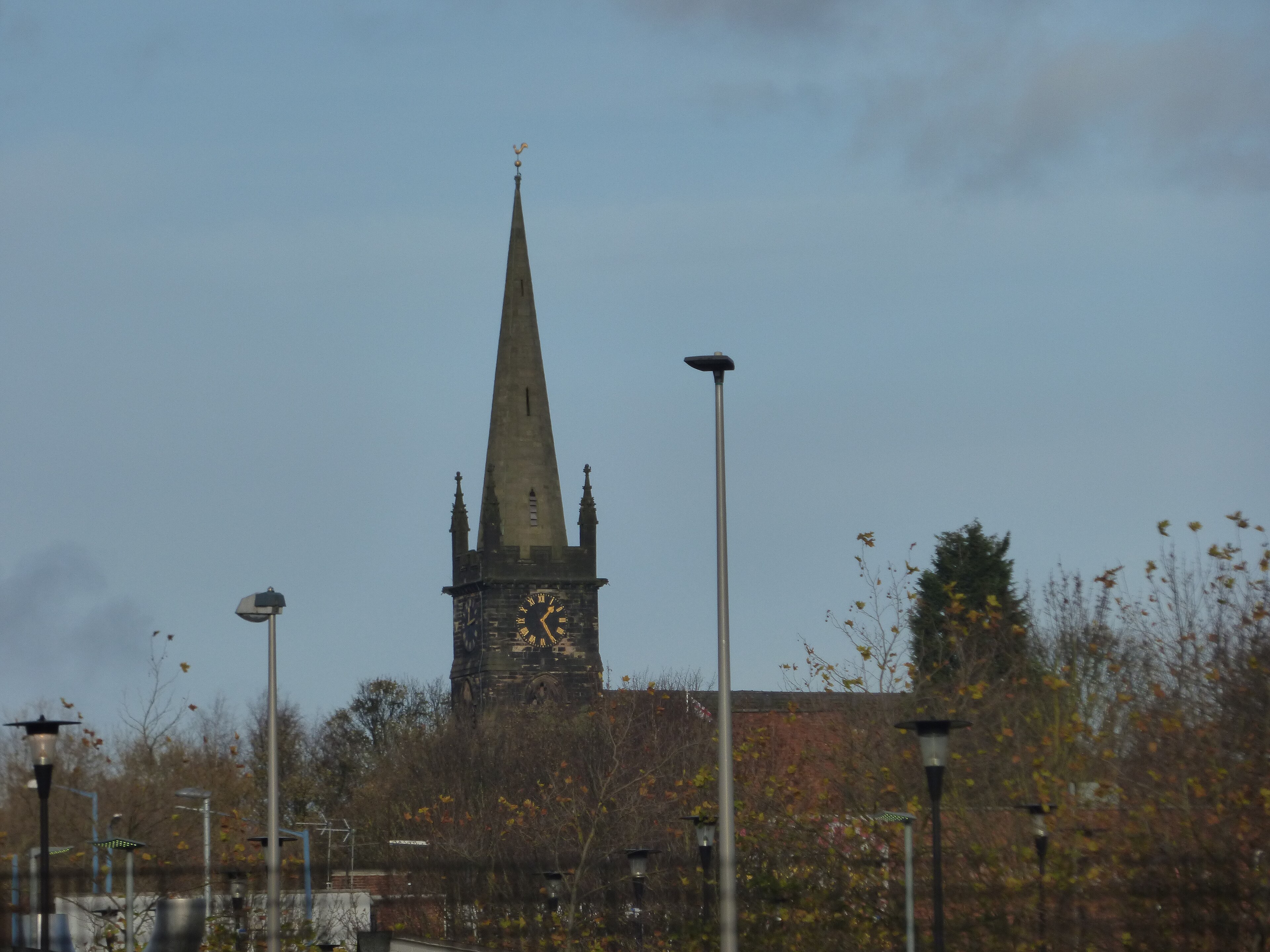
St Bartholomew's Church on Church Hill, close to the historic focus of the early Wednesbury settlement.
Image credit: Photograph: Elliott Brown · Source: Flickr / Wikimedia Commons · CC BY-SA 2.0 · Image date: 19 November 2017
The Market Place develops
Wednesbury’s historic Market Place grew where important routes through the settlement met.
Interestingly, Sandwell’s archaeological research says there is no known medieval market charter. Nevertheless, excavations show buildings and yards fronting the triangular Market Place by the fourteenth or fifteenth century.
By 1421 the settlement had expanded farther northeast, where a manor house known as Oakeswell Hall was constructed.
Oakeswell Hall survived for centuries before finally disappearing during redevelopment in the 1960s.
The Market Place nevertheless remained an important part of Wednesbury’s identity and continues to form the historic core of the town centre today.
Industry before the Industrial Revolution
Wednesbury’s industrial history is particularly remarkable because it did not suddenly begin with the steam engine.
The geology beneath and around the town provided coal, iron ore, clay and sandstone, all of which could be exploited.
Coal pits and ironstone mining are documented in the area by 1315.
Wednesbury also developed an early pottery industry.
From around the fourteenth century, locally produced pottery known as Wedgebury Ware was manufactured around the town. Archaeological evidence has identified production sites around the Market Place and Lower High Street, including activity continuing into the seventeenth century.
This means Wednesbury already had a substantial manufacturing tradition centuries before the landscape became synonymous with heavy industry.
Iron and the forge
Ironworking became another defining feature of Wednesbury.
By the sixteenth century, manorial water-powered mills in the area had been converted to iron production.
Wednesbury Forge, northeast of the town, developed into a sophisticated industrial operation by the late sixteenth and early seventeenth centuries. Established transport routes allowed its products to move through the town and beyond.
Ironworking would remain associated with Wednesbury for generations.
Nails, tools, iron products and eventually increasingly sophisticated manufactured goods emerged from workshops and factories across the district.
Coal changes everything
During the eighteenth century the scale of industrial activity increased dramatically.
Earlier shallow coal pits gave way to deeper workings as demand for fuel increased. Collieries developed around Wednesbury and the surrounding Black Country.
Coal supplied local ironworking and other manufacturing industries, while improved transport allowed materials and finished goods to reach larger markets.
The physical landscape changed with it.
Mines, spoil heaps, furnaces, workshops and workers’ housing increasingly replaced agricultural land.
By the nineteenth century Wednesbury had become part of the extraordinary interconnected industrial landscape of the Black Country.
A history of Wednesbury published in 1854 described the view from Church Hill surrounded by the furnaces and industrial activity of neighbouring West Bromwich, Tipton, Coseley, Bilston and Darlaston.
Canals and railways
Industrial expansion required better transport.
The developing Black Country canal system provided an efficient way of moving coal, iron and other heavy goods.
Railways later added faster connections for both freight and passengers.
Together with the old road network, these routes connected Wednesbury with Birmingham, Wolverhampton and the surrounding industrial towns.
Factories could obtain raw materials more easily and send their products farther afield.
Workers could also travel farther for employment.
Wednesbury was becoming part of an increasingly interconnected urban region.
A growing Victorian town
Industrialisation brought population growth.
Workers and their families needed homes, shops, schools, churches and public services.
Streets spread around the old centre and previously open areas became increasingly urban.
The Market Place and surrounding streets developed into a busy commercial centre.
Public buildings demonstrated Wednesbury’s increasing civic confidence.
One of the most prominent survivors is Wednesbury Town Hall, constructed in 1874 in an Italianate style. It originally served as the seat of Wednesbury’s local government and remains an important civic building.
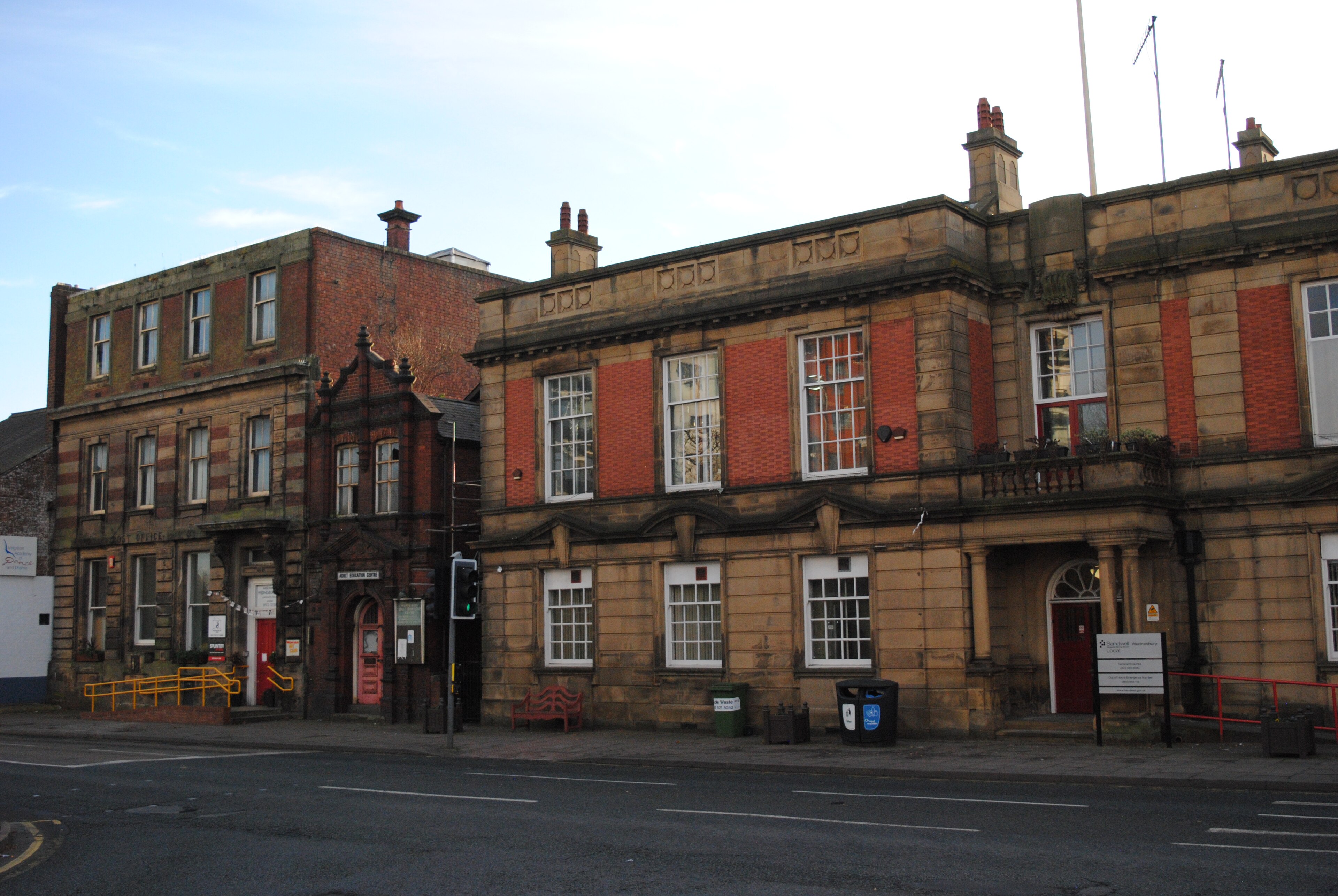
Wednesbury Town Hall, a surviving reminder of the civic confidence created as the industrial town expanded.
Image credit: Photograph: Andy Mabbett · Source: Wikimedia Commons · CC BY-SA 4.0 · Image date: 30 November 2016
Culture and the Museum
Industrial towns were not concerned solely with factories.
Wednesbury developed cultural institutions as well.
The Wednesbury Museum and Art Gallery became an important part of the town’s civic landscape. Today it preserves collections ranging from Victorian paintings and historic toys to the internationally significant collection of Ruskin Pottery.
That pottery collection provides an interesting contrast with Wednesbury’s reputation for heavy industry.
The Black Country produced coal, iron and engineering products, but it also produced decorative arts and highly skilled craftsmanship.
Wednesbury in the twentieth century
The twentieth century brought another period of enormous change.
Traditional industries declined or disappeared.
Collieries closed.
Industrial sites were redeveloped.
Housing clearance transformed older residential districts, while new estates accommodated changing populations.
Road transport increasingly replaced some of the railway and canal traffic that had previously served industry.
Yet the historic centre survived many of these changes.
The architectural and historic importance of the Market Place was formally recognised when the Wednesbury Market Place Conservation Area was designated in 1980. Its boundary was most recently reviewed in 2024.
Becoming part of Sandwell
Local government changed significantly during the twentieth century as well.
Wednesbury’s independent municipal identity eventually became part of a larger administrative structure.
In 1966, Wednesbury was incorporated into the new County Borough of West Bromwich.
Further reorganisation followed in 1974, when West Bromwich and Warley were combined to create the Metropolitan Borough of Sandwell.
Wednesbury became one of Sandwell’s six principal towns.
Its local identity, however, remained very strong.
Wednesbury today
Modern Wednesbury contains traces of almost every period of its history.
Church Hill preserves the location of the ancient settlement.
The Market Place retains the form of the historic town centre.
Victorian civic buildings reflect the confidence created during industrial expansion.
Former industrial land records the enormous economic changes of the nineteenth and twentieth centuries.
And beneath the modern landscape lie much older archaeological remains associated with mining, pottery and manufacturing.
This is what makes Wednesbury particularly fascinating.
Its history cannot simply be divided into “before industry” and “after industry.”
Industry itself has ancient roots here.
Coal and ironstone were being exploited by the early fourteenth century. Pottery was being manufactured during the medieval period. Water-powered mills became ironworks. Those early industries eventually developed into the much larger industrial landscape for which the Black Country became famous.
Wednesbury therefore provides something unusual within Sandwell:
a continuous story stretching from an ancient settlement, through medieval industry and the Industrial Revolution, to the modern Black Country town of today.