The centre of West Bromwich that generations of shoppers remember — the long High Street, Town Hall, shops, markets and civic buildings — is not the original heart of the settlement.
That earlier West Bromwich lay farther north.
Over several centuries, changing roads, enclosure, industrial growth and Victorian development gradually shifted the focus of the town. Later generations then rebuilt parts of the centre again.
The result is unusual: the story of West Bromwich can partly be told through the movement of the town itself.
The old village
Before industrialisation, West Bromwich was a scattered rural community.
The historic settlement developed around All Saints Church, with farms, cottages and larger houses distributed across the surrounding countryside.
Nearby stood Bromwich Hall — now usually called West Bromwich Manor House — whose medieval hall dates from around the late thirteenth century.
Bromwich Heath
South of the older settlement was Bromwich Heath.
For centuries this was comparatively open land rather than a conventional town centre.
That began to change dramatically in the early nineteenth century.
The heath was enclosed in 1804, allowing land to be divided and developed. At roughly the same time, improvements to the Birmingham–Wolverhampton road made the route increasingly important. Sandwell’s historic-landscape research identifies these changes as significant factors in the movement of development towards what became the modern High Street.
Housing, businesses and industry gradually appeared along the road.
The centre of gravity was beginning to move.
A remarkably wide High Street
One of the defining characteristics of historic West Bromwich was its unusually broad High Street.
By the Victorian period it had developed into the commercial spine of the town.
The road was more than somewhere to travel through. Shops, banks, inns, churches and businesses increasingly clustered along it.
The former heath was becoming urban West Bromwich.
Development accelerated as industrial employment attracted a growing population. New streets spread away from the main road and filled previously open land.
By the middle of the nineteenth century, the shape of the modern town was becoming recognisable.
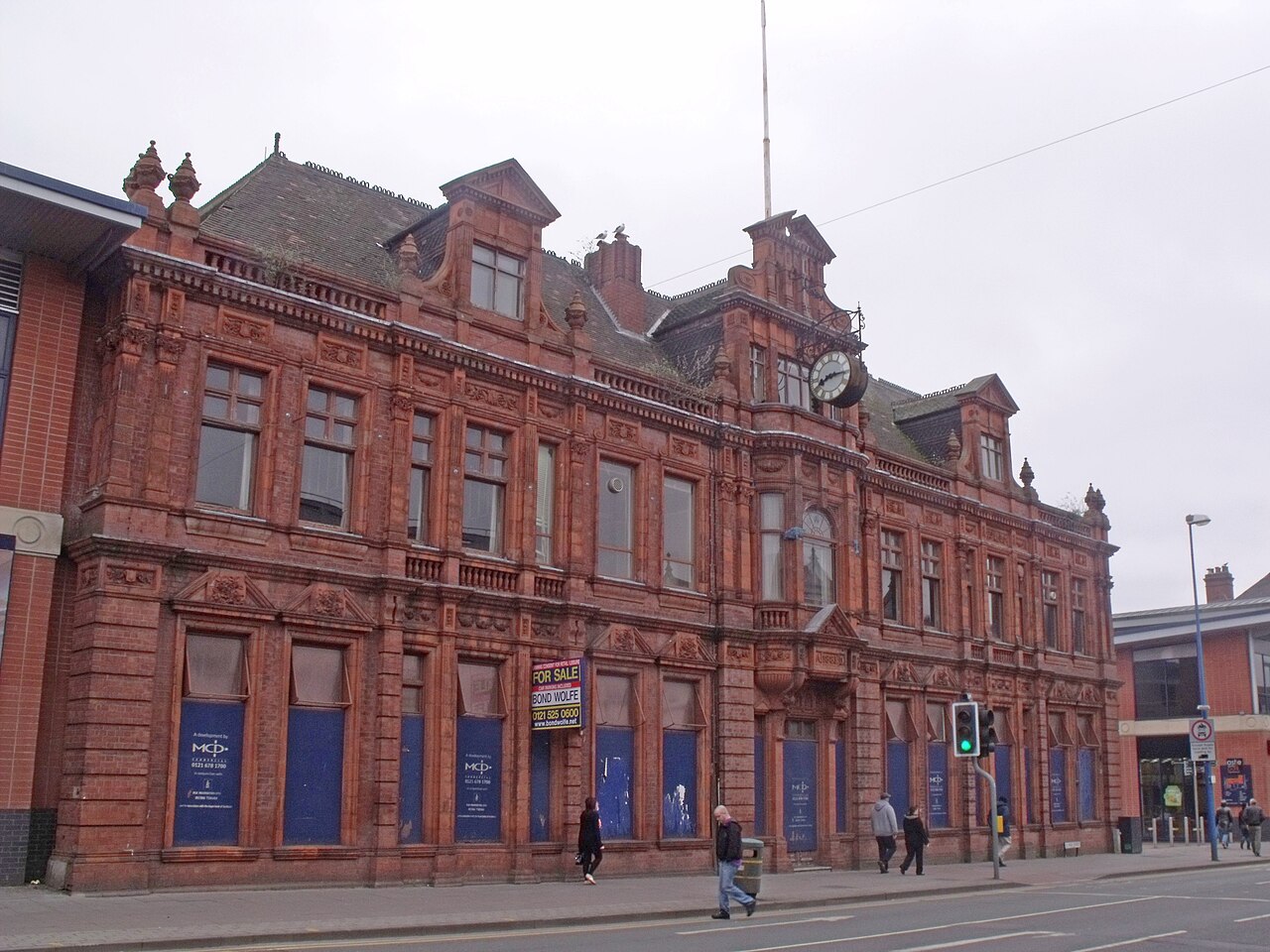
The former offices of Kenrick & Jefferson on West Bromwich High Street, part of the historic streetscape of the town centre.
Image credit: Photograph: Elliott Brown · Source: Flickr / Wikimedia Commons · CC BY 2.0 · Image date: 20 March 2011
The railway arrives
Transport reinforced the shift.
West Bromwich railway station opened in 1854, connecting the growing town with the regional railway network.
Railways allowed workers, visitors and goods to travel rapidly between West Bromwich and neighbouring industrial centres.
Meanwhile, canals and increasingly improved roads continued carrying industrial traffic.
West Bromwich was no longer an isolated settlement.
It had become part of a vast interconnected Black Country industrial landscape.
Building a civic centre
Perhaps the clearest evidence that the town’s focus had shifted came with the construction of major public buildings.
During the Victorian period, local government became increasingly ambitious.
The most obvious expression of that confidence was West Bromwich Town Hall, opened in 1875.
Its architecture was deliberately impressive.
This was not simply an administrative office. It was a statement that West Bromwich considered itself an important urban community.
Nearby institutions reinforced the area as the civic heart of the town.
The Golden Mile
As development continued, the High Street became part of what local people came to know as West Bromwich’s Golden Mile.
The long commercial route extended between Carters Green and Three Mile Oak.
Its scale made West Bromwich unusual.
Rather than developing around a compact market square, much of the town’s commercial activity stretched along a long linear route.
For generations, residents could find almost everything there: shops, banks, public houses, entertainment venues, churches and municipal buildings.
Different sections developed their own character.
Carters Green remained an important shopping area, while the central High Street increasingly became associated with larger shops and civic institutions.
Trams transform the street
Public transport changed the High Street again.
Electric tramways became an important feature of Black Country towns during the early twentieth century, and West Bromwich was no exception.
Trams brought large numbers of people directly into the shopping centre and strengthened the High Street’s position as the commercial heart of the town.
Eventually buses replaced them, but public transport continued to shape shopping patterns.
Shopping and entertainment
By the twentieth century, West Bromwich had developed into a major shopping destination.
Independent shops stood alongside national chains.
Markets brought shoppers into the centre.
Cinemas, public houses and other entertainment venues added to the crowds.
Saturday shopping became part of local life.
The High Street wasn’t simply somewhere people bought things. It was somewhere people met friends, travelled through, worked and socialised.
For many residents of neighbouring districts, a journey into West Bromwich meant going into town.
The motor car changes everything
The success of the High Street eventually created a problem.
It had developed around pedestrians, trams, buses and relatively modest levels of road traffic.
The rapid growth of car ownership after the Second World War placed enormous pressure on this arrangement.
Traffic increasingly competed with shoppers and public transport.
Town planners across Britain responded to similar problems with radical redevelopment schemes.
West Bromwich would experience the same treatment.
Post-war redevelopment
During the second half of the twentieth century, parts of central West Bromwich were substantially rebuilt.
Older buildings disappeared.
New roads diverted traffic.
Pedestrian shopping areas were introduced.
Large car parks became necessary.
Shopping increasingly moved into purpose-built centres rather than remaining entirely along the traditional street frontage.
The ring road fundamentally changed movement around the centre.
These schemes reflected the planning ideas of their period: vehicles would circulate around town centres while pedestrians shopped within largely traffic-free areas.
But they also altered connections between different parts of West Bromwich.
The High Street that earlier generations had known began to fragment.
Another generation of redevelopment
Even the post-war developments did not remain unchanged.
Shopping habits continued evolving.
Traditional industries declined.
Competition from neighbouring centres increased.
Later regeneration schemes therefore attempted once again to reshape West Bromwich.
New retail developments appeared and public spaces were redesigned.
The arrival of the West Midlands Metro returned rail-based street transport to central West Bromwich in a modern form, reconnecting the town directly with Birmingham and Wolverhampton.
The story had almost come full circle.
Transport had helped create the Victorian centre, and transport was again being used as part of its regeneration.
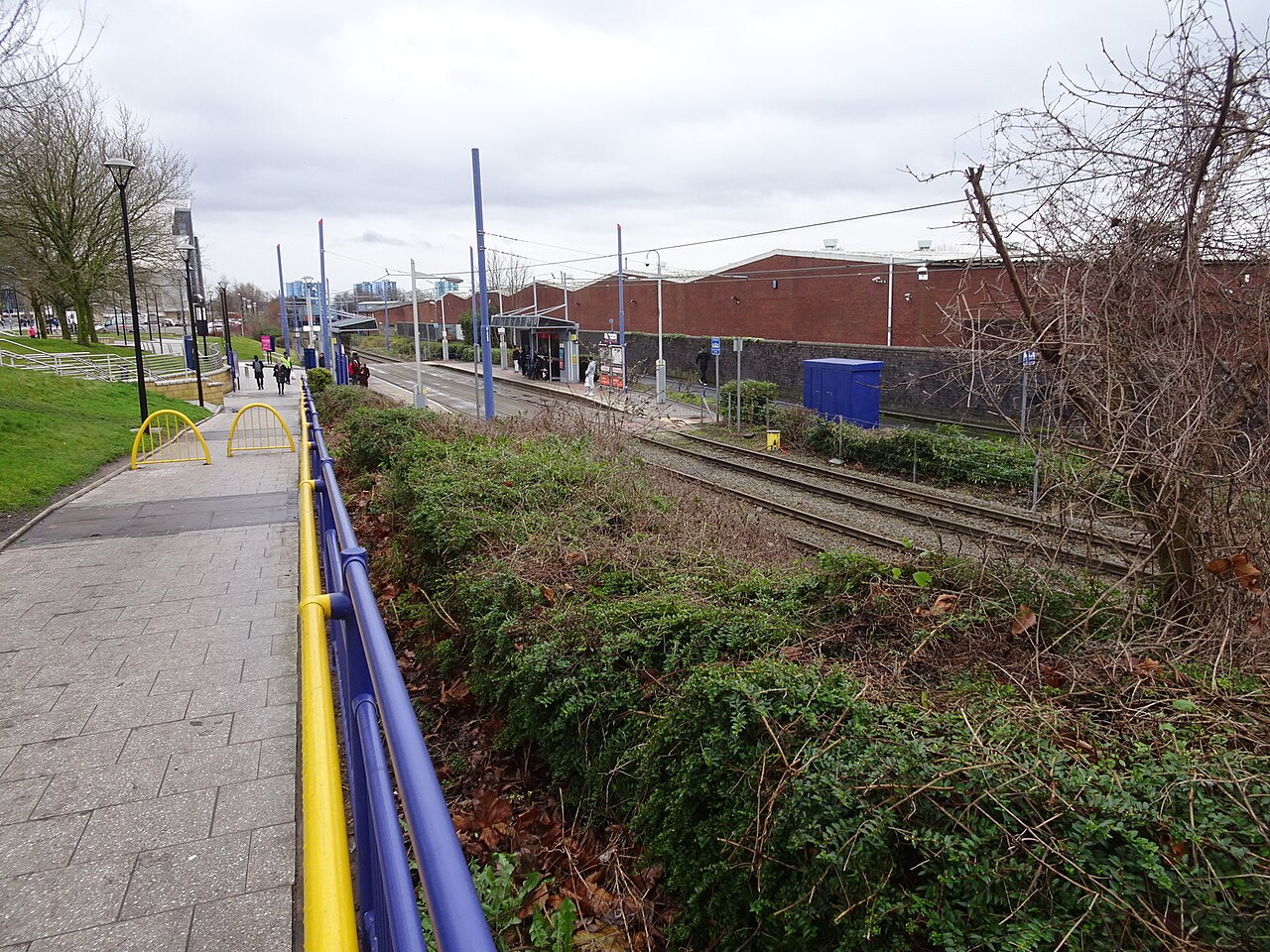
West Bromwich Central tram stop occupies the site of the former West Bromwich railway station, which opened in 1854.
Image credit: Photograph: Nigel Thompson · Source: Geograph Britain and Ireland / Wikimedia Commons · CC BY-SA 2.0 · Image date: 24 January 2018
Reading the old town today
Despite repeated redevelopment, fragments of earlier West Bromwich survive.
The Town Hall and Central Library still dominate part of the High Street.
Carters Green retains its identity.
Older buildings survive between later developments.
Street alignments preserve routes that existed long before the modern shopping centres surrounding them.
And farther north, around All Saints and the Manor House, visitors can still find the landscape associated with the earlier settlement.
Walking between those places effectively means walking through different periods of West Bromwich history.
A town whose centre moved
West Bromwich did not simply expand around one historic centre.
Its focus changed.
The medieval and early-modern settlement developed around the old village.
The enclosure of Bromwich Heath opened new land for development.
The Birmingham–Wolverhampton road evolved into the High Street.
Industry attracted population.
Victorian civic buildings established a new administrative centre.
Shops and public transport created the Golden Mile.
Twentieth-century planners then rebuilt substantial parts of it.
Modern regeneration changed it again.
Understanding this helps explain why West Bromwich sometimes feels like a town containing several different centres.
It does.
Each represents a different chapter in its history.
And beneath the modern shopping streets lies the story of how the heart of West Bromwich gradually moved from an old Black Country village to one of the region’s major urban centres.