Long before factories and collieries transformed the Black Country, churches were among the most important buildings in the settlements that would eventually become modern Sandwell.
They were places of worship, but their importance extended much further.
Churches recorded baptisms, marriages and burials. Churchyards became resting places for generations of local families. Religious organisations provided education, charity and community support, while church towers and spires became familiar landmarks.
Industrialisation then transformed this religious landscape.
As Smethwick, Oldbury, West Bromwich, Wednesbury, Tipton and Rowley Regis expanded, new Anglican churches, Roman Catholic churches and Nonconformist chapels were established to serve rapidly growing populations.
Many have disappeared, but those that survive provide another way of reading Sandwell’s history.
Before the Industrial Revolution
The religious history of Sandwell reaches much further back than the industrial towns familiar today.
Historic parish churches served communities when much of the surrounding landscape consisted of fields, farms and scattered settlements.
The importance of these early churches was partly administrative as well as religious.
Before modern civil registration, parish registers were among the principal ways in which important events in people’s lives were recorded.
Baptisms, marriages and burials created records that can still allow families to trace people who lived locally centuries ago.
Sandwell Archives continues to preserve church and chapel records, including registers, churchwardens’ accounts, meeting minutes, property records, parish magazines and photographs.
Wednesbury’s historic parish church
One of Sandwell’s most interesting surviving parish churches is St Bartholomew’s Church in Wednesbury.
The present building contains medieval remains, although much of its appearance reflects later rebuilding and alteration.
Historic England dates substantial parts of the church to around 1827, while noting surviving fourteenth-century fabric. The building was altered and extended by architect Basil Champneys in 1890 and later underwent further work.
Its long history illustrates something easily forgotten when looking at today’s urban Black Country.
Wednesbury existed as a community for centuries before nineteenth-century industry transformed its surroundings.
The church therefore connects modern Wednesbury with a much earlier landscape.
Christ Church and Victorian Oldbury
Christ Church became one of Oldbury’s prominent nineteenth-century religious landmarks. Built in 1841, the red-brick Gothic Revival church reflects the period in which Oldbury was developing rapidly as an industrial town.
Its scale and prominent tower demonstrate the increasingly important place occupied by churches within expanding Victorian communities.
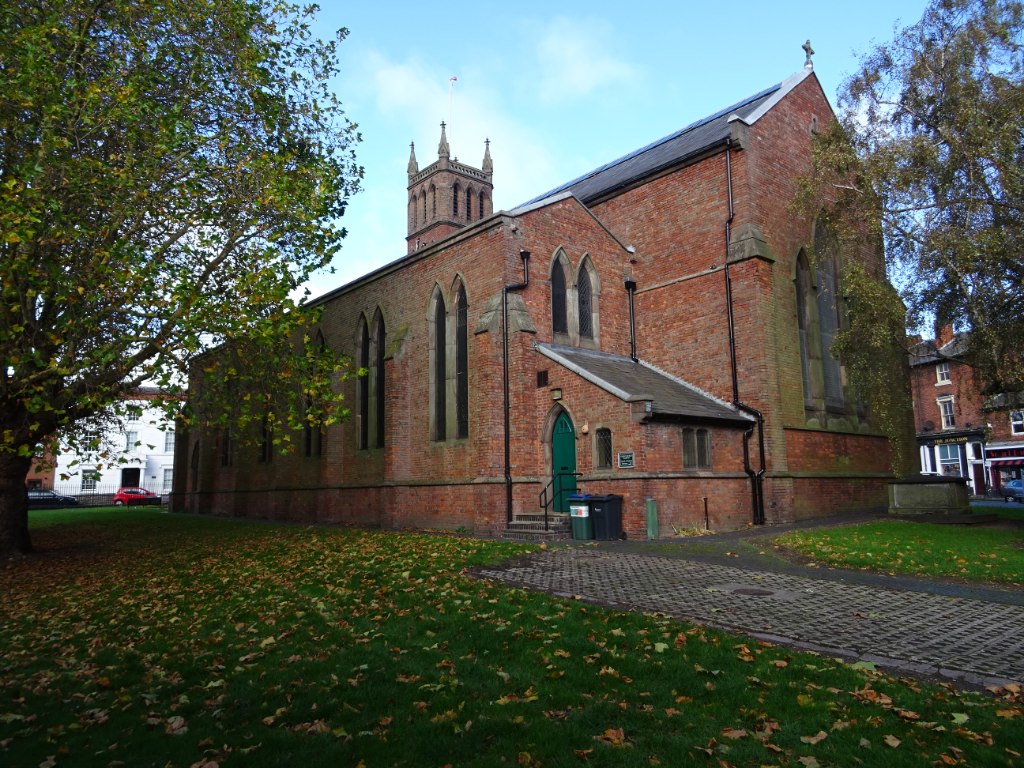
Christ Church in Oldbury, a prominent nineteenth-century church completed in 1841.
Image credit: Photograph: Philip Halling · Source: Geograph Britain and Ireland · CC BY-SA 2.0 · Image date: 26 October 2018
Churches for growing industrial towns
Industrialisation created an enormous challenge for established churches.
Populations expanded rapidly as workers moved into areas dominated by mines, furnaces, factories and engineering works.
Existing parish churches could not always accommodate these growing communities.
New churches and chapels were therefore built across the Black Country.
Tipton provides a particularly good example.
The Church of St Martin and St Paul on Owen Street was originally built as St Paul’s in 1837–38. Historic England records that it was designed by Robert Ebbles in a Commissioners’ Gothic style.
It was constructed as a chapel of ease to St Martin’s specifically to serve Tipton’s rapidly expanding population, particularly around Tipton Green as that area developed into the town centre.
The church is therefore directly connected with Tipton’s industrial expansion.
St Martin’s and an older Tipton
Tipton also retains another important historic church.
The Church of St Martin on Lower Church Lane dates from 1795–97 and was designed by F. Keyte of Kidderminster.
The building subsequently experienced serious problems associated with mining subsidence and was partly rebuilt during the early 1960s.
That history captures an unusual interaction between religion and industry.
The church existed before Tipton reached the height of its industrial development, but the effects of the industries surrounding it eventually altered the building itself.
Mining did not merely reshape employment and the landscape.
It could affect structures standing above the workings.
Nonconformity in the Black Country
The Church of England represented only part of Sandwell’s religious history.
Methodists, Baptists and other Nonconformist communities established numerous chapels and meeting places across the six towns.
Sandwell Archives specifically records holdings from many Nonconformist churches, including Methodist and Baptist chapels, alongside its Anglican parish collections.
Surviving registers demonstrate how geographically widespread these communities became.
Archive listings include Baptist records associated with places such as Rowley Regis, West Bromwich, Smethwick and Wednesbury.
Chapels could become important neighbourhood institutions, particularly within working-class industrial communities.
Some occupied substantial buildings on prominent streets. Others were smaller local meeting places.
Many have since disappeared or been converted to other uses.
St Giles and Rowley Regis
The parish church of St Giles has long been an important landmark in Rowley Regis.
The church stands high within the historic settlement, continuing a religious presence associated with Rowley Regis across generations. Like other prominent parish churches in Sandwell, it provides a physical connection between the modern town and the community that existed before large-scale twentieth-century redevelopment.
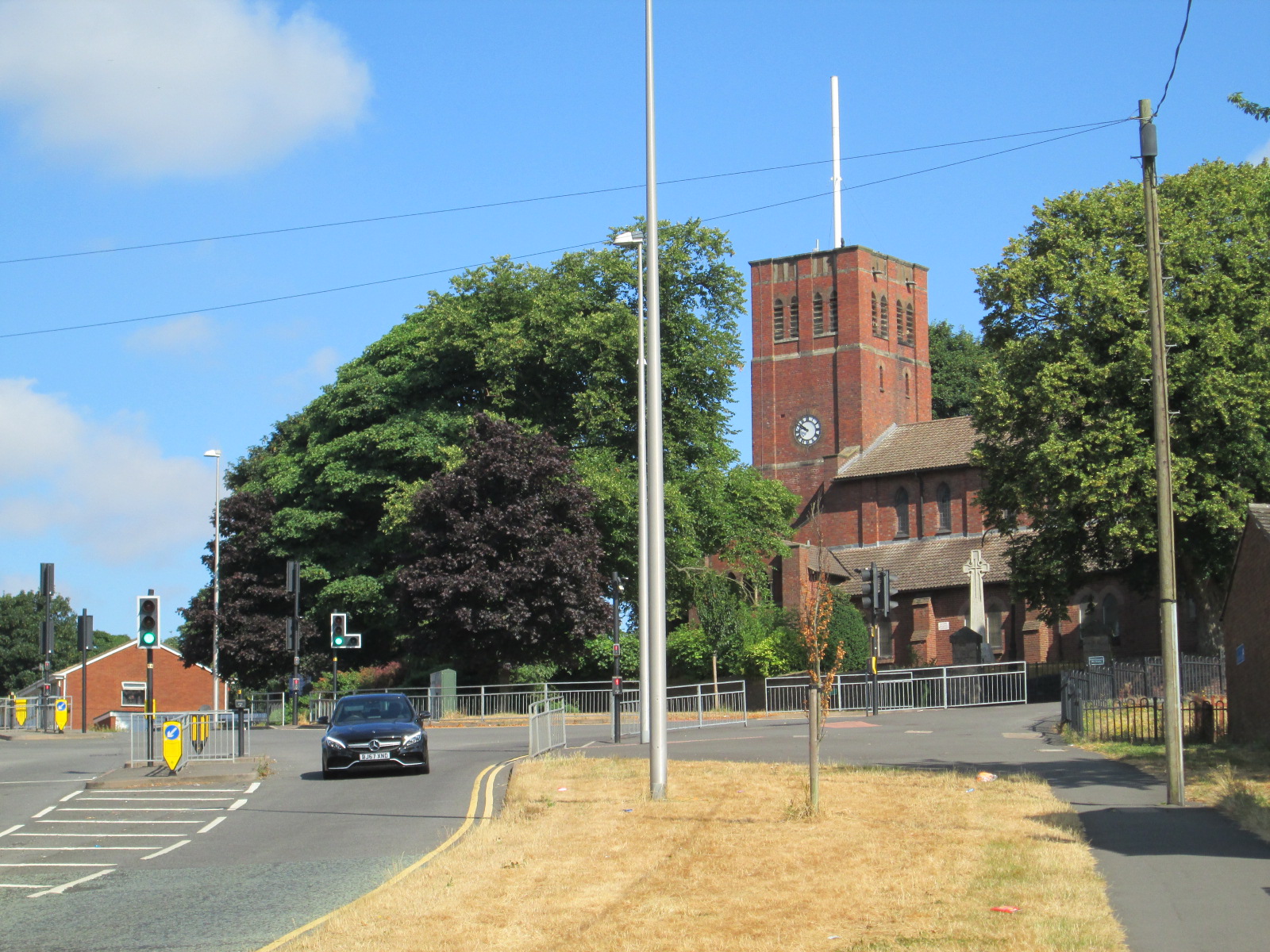
St Giles' Church, a long-standing religious landmark in Rowley Regis.
Image credit: Photograph: David Weston · Source: Geograph Britain and Ireland / Wikimedia Commons · CC BY-SA 2.0 · Image date: 15 July 2018
Roman Catholic communities
Roman Catholic churches also became part of Sandwell’s changing religious landscape.
In Wednesbury, the Church of St Mary was constructed in 1873–74 to designs by architect Gilbert Blount. The Grade II listed building was built in brick and limestone and includes a nave, aisles, tower and sanctuary.
Other significant twentieth-century Roman Catholic churches survive elsewhere in Sandwell.
Historic England’s Sandwell heritage material identifies examples including Our Lady and St Hubert in Oldbury, dating from 1934, and Our Lady of Good Counsel and St Gregory in Smethwick, dating from 1933–34.
Their architecture provides evidence of the continuing development of religious communities well beyond the Victorian period.
Churches at the heart of community life
Places of worship often provided far more than Sunday services.
Church halls hosted organisations and social events.
Religious bodies became involved in education.
Charitable work supported local families.
Youth organisations, choirs and clubs brought people together.
Church calendars structured events throughout the year, while baptisms, weddings and funerals connected religious buildings with important moments in people’s lives.
For many residents, therefore, a church or chapel could be both a religious institution and an important centre of neighbourhood life.
Church schools and education
Religion also played an important role in education before state provision became universal.
Churches and religious organisations established schools across the Black Country.
As we saw in the history of Sandwell’s schools, Victorian educational provision did not begin solely with government school boards.
Church schools and other voluntary institutions were already educating children before the major expansion of publicly organised schooling during the late nineteenth century.
This relationship between education and religion survives in the names and traditions of numerous schools across the borough.
Churchyards as historical records
Churchyards provide another remarkable source of local history.
A gravestone can record names, family relationships, occupations and dates that may otherwise be difficult to discover.
Sandwell Council notes that local churchyards and cemeteries contain significant historical and social information. Churchyard records are also preserved by Sandwell Community History and Archives Service.
Some burial places contain memorials to people whose lives connect local history with much wider events.
For family historians, church registers and burial records can be particularly important because they allow generations of a family to be connected with a specific community.
What survives in the archives
The documentary record of Sandwell’s religious communities is extensive.
Sandwell Archives holds material from Anglican parishes and many Nonconformist churches.
Its faith collections include:
baptism, marriage and burial registers; early poor-relief records; churchwardens’ accounts; minutes of church meetings; documents concerning buildings and property; parish magazines; and photographs.
Importantly, the archive states that its church and chapel catalogues are not currently available online in full. Researchers are advised to contact the service for further information.
This means the surviving documentary record is considerably richer than an internet search alone might suggest.
Religion and migration
Sandwell’s religious landscape did not stop changing when the Victorian churches were completed.
During the twentieth century, migration brought new communities, traditions and places of worship to the borough.
Some older religious buildings found new congregations or new uses, while completely new places of worship appeared.
This continuing change reflects Sandwell’s wider social history.
The borough’s religious landscape today therefore represents many different periods: historic parish churches, Victorian chapels, twentieth-century churches and places of worship associated with communities that arrived during the post-war decades.
When churches disappear
Not every historic place of worship survives.
Changing populations, declining congregations, redevelopment and the cost of maintaining large buildings have resulted in closures and demolitions.
Some former churches and chapels have been converted into homes, businesses or community buildings.
Others have vanished entirely.
Historic maps can sometimes reveal chapels occupying street corners where no obvious trace survives today.
Old photographs may provide the only visual evidence of their appearance.
This makes recording surviving buildings especially important.
Familiar landmarks
Churches are particularly significant within local history because they often survive while almost everything around them changes.
Housing can be rebuilt.
Factories can disappear.
Shopping streets can be redeveloped.
Yet a church tower or spire may remain visible through generations of transformation.
For residents returning to an area after many years away, these surviving landmarks can provide an immediate geographical connection with the place they remember.
Faith as part of Sandwell’s history
The history of Sandwell’s churches and chapels is ultimately a history of people.
Their buildings reflect architectural fashion and population growth, but their records preserve millions of individual moments: births, marriages, deaths, meetings, celebrations and periods of hardship.
Some churches connect today’s urban Sandwell with settlements that existed centuries before industrialisation.
Others were built specifically because industrialisation created entirely new communities.
Together with chapels and later places of worship, they form an important layer of Sandwell’s historical landscape.
By preserving their buildings, photographs, records and memories, we retain another part of the story of the six towns.
Sources & Further Reading
Sandwell Archives — Faith Records
Historic England — St Bartholomew’s Church, Wednesbury
Historic England — Church of St Martin and St Paul, Tipton
Historic England — Church of St Martin, Tipton
Historic England — St Mary’s Roman Catholic Church, Wednesbury