Smethwick’s history is a story of extraordinary change. Once a comparatively small settlement on the edge of Birmingham, it became one of the most important industrial towns of the Black Country, shaped by canals, engineering, glassmaking and generations of people who came to live and work here.
Today, traces of that transformation can still be found throughout the town — in its canals, factories, public buildings, parks, streets and surviving industrial sites.
From Rural Settlement to Industrial Town
For much of its early history, Smethwick was considerably smaller than the densely developed town we recognise today.
That began to change dramatically during the Industrial Revolution.
One of the most important developments was the arrival of the Birmingham Canal in the eighteenth century. The canal through Smethwick opened in 1769 and became part of a transport network connecting Birmingham with the industrial Black Country.
The difficult terrain around Smethwick initially required the canal to climb to the famous Smethwick Summit.
As industrial traffic increased, improvements were needed. Thomas Telford’s Birmingham Canal New Main Line, opened through the area in the 1820s, provided a faster and more efficient route.
The resulting canal landscape around Galton Valley remains one of the clearest reminders of Smethwick’s industrial development.
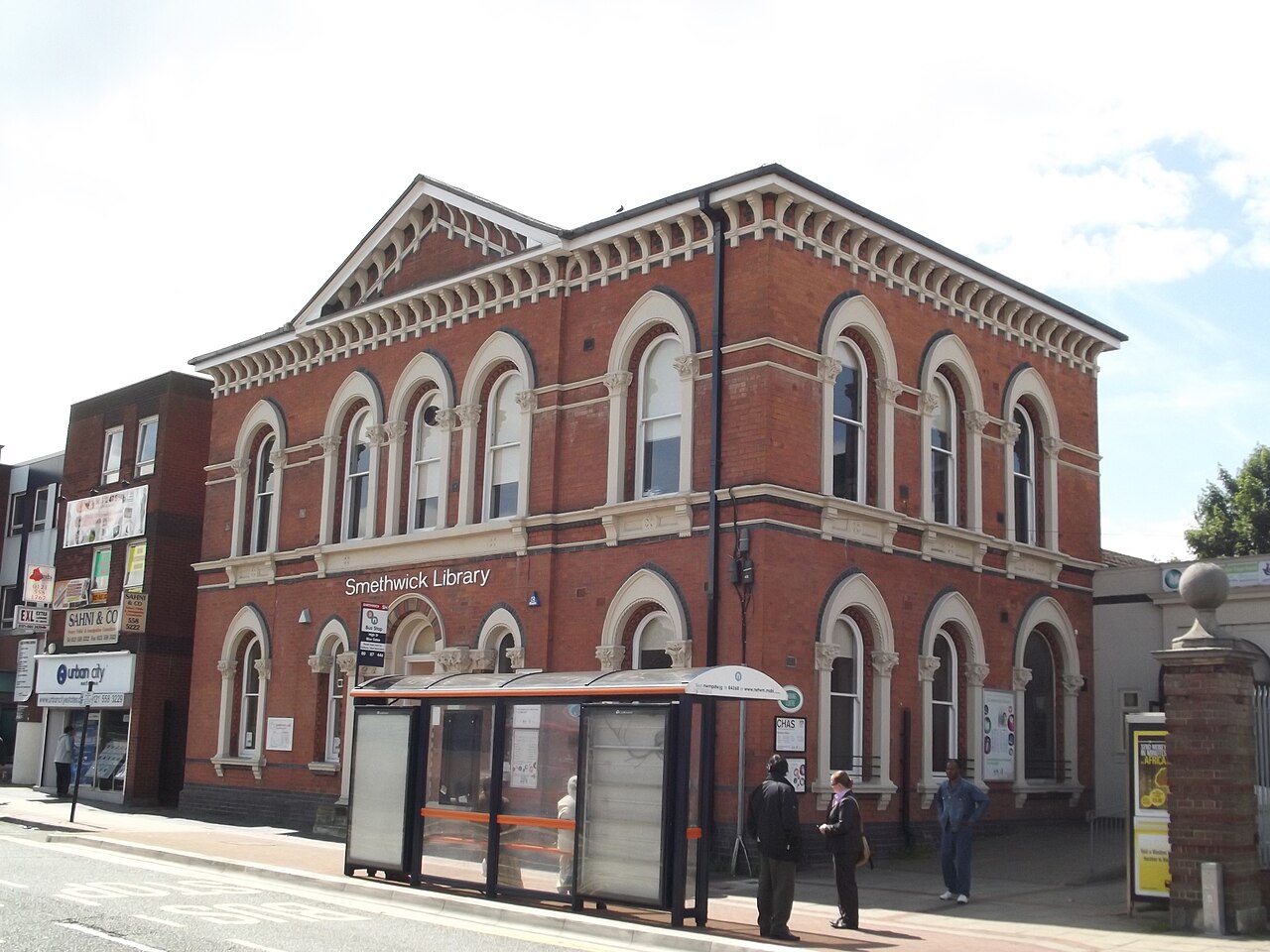
Smethwick Library, High Street.
Image credit: Photograph: Elliott Brown · Source: Wikimedia Commons · CC BY 2.0 · Image date: 19 June 2012
Boulton & Watt and Soho Foundry
Smethwick also played an important part in the development of steam power.
In 1795–96, the Soho Foundry was established beside the canal in Smethwick by the Boulton and Watt enterprise.
Unlike earlier methods in which components might be produced at several different locations, Soho Foundry brought the manufacture and assembly of steam engines together on one site.
Historic England regards the surviving remains as being of national importance.
The foundry was associated with some of the great names of the Industrial Revolution, including Matthew Boulton, James Watt and William Murdoch.
In December 1798, experiments by Murdoch resulted in the main foundry becoming the first industrial building in the world to be illuminated using gas produced on site.
The surviving Soho Foundry buildings provide a remarkable physical connection between modern Smethwick and the beginnings of industrial engineering.
Chance Brothers
Another company would make the name Smethwick known far beyond Britain.
The works that became Chance Brothers were acquired by Robert Lucas Chance in 1824.
The company developed into one of Britain’s most important glass manufacturers.
James Timmins Chance joined the partnership in 1839 and played an important part in improving the manufacture, grinding and polishing of sheet glass.
Chance glass was subsequently used in some extraordinary projects.
The company supplied approximately 28,000 square feet of glass for the Houses of Parliament and more than 956,000 square feet for the original Crystal Palace constructed for the Great Exhibition of 1851.
Chance Brothers also became internationally renowned for lighthouse optics.
Its lenses and optical equipment eventually guided ships around coastlines across the world.
The remains of the Chance glassworks beside the Birmingham Canal Navigations remain among Smethwick’s most important pieces of industrial heritage.
A Growing Town
Industry brought employment, and employment brought people.
Factories required enormous workforces, while streets of houses, shops, schools, churches and public buildings were constructed to serve the rapidly expanding population.
The physical character of Smethwick changed accordingly.
Areas that had once been fields and scattered development became tightly packed neighbourhoods connected by roads, canals and railways.
Smethwick increasingly developed its own civic identity rather than simply existing in Birmingham’s shadow.
Public parks, libraries, schools and municipal buildings became part of the landscape of the growing town.
Smethwick in the Twentieth Century
The twentieth century brought further enormous changes.
The factories that had driven Smethwick’s growth continued to employ thousands of people, while the town became home to communities arriving from many different parts of Britain and overseas.
Housing changed too.
Older properties were demolished in some districts, while council estates, maisonettes and tower blocks transformed parts of the landscape during the post-war period.
Later in the century, industrial decline brought another period of change.
Factories closed or contracted. Industrial sites were demolished or redeveloped. Streets disappeared and new roads, housing and shopping developments altered familiar neighbourhoods.
Yet many reminders of the industrial town survived.
Smethwick Today
Modern Smethwick is layered with evidence of its past.
Victorian streets stand alongside post-war housing.
Former factories sit beside modern industrial estates.
Canals built to carry the products of the Industrial Revolution have become walking routes and wildlife corridors.
Parks created for growing Victorian and Edwardian communities continue to serve residents more than a century later.
Some historic buildings have disappeared completely. Others survive with different uses.
And beneath the modern landscape are still more forgotten features — old waterways, demolished streets, former factories and traces of communities that once occupied them.
These layers are what make the history of Smethwick so fascinating.
The story of the town cannot be told through one building or one industry.
It is the combined history of its streets, factories, canals, parks, schools, pubs, places of worship and, above all, its people.
That is the history The Sandwell Walker is working to record and preserve.