Few forces changed Smethwick as dramatically as industry.
During the eighteenth and nineteenth centuries, canals, factories, engineering works and glassmaking transformed the area from a relatively small settlement into a densely populated industrial town.
Some of the innovations developed here influenced manufacturing far beyond the Black Country.
The Canal Changes Everything
Transport was essential to industrial development.
Heavy raw materials such as coal, iron and other goods were expensive and difficult to move over poor roads.
The arrival of the Birmingham Canal through Smethwick in 1769 therefore represented a major change.
It connected the area to Birmingham and the wider Black Country canal system, allowing raw materials and manufactured goods to move on an unprecedented scale.
Smethwick presented the canal engineers with a problem, however: the land was too high.
The original solution became the Smethwick Summit, where boats had to climb through locks before descending again.
As traffic increased, the summit became a serious bottleneck.
Further engineering eventually produced increasingly efficient routes through the landscape, culminating in Thomas Telford’s New Main Line through Galton Valley during the 1820s.
The enormous cutting and its bridges created one of the Black Country’s great industrial landscapes.
Steam Power Comes to Smethwick
Alongside the canals came another technology that would transform the world: the steam engine.
The Soho Foundry was established in Smethwick in 1795–96.
Associated with Matthew Boulton and James Watt and developed particularly by the next generation of their families, it represented a new approach to manufacturing steam engines.
Previously, different components could be produced by separate workshops and manufacturers.
At Soho, engine manufacture was brought together into an integrated engineering works.
Historic England describes the site as one of the earliest purpose-built steam-engine manufactories in the world.
The foundry produced engines and developed into an important marine-engine business during the nineteenth century.
Its engineering achievements even became connected with one of the most celebrated ships of the Victorian age: Brunel’s Great Eastern, for which the company manufactured screw engines.
William Murdoch and Gas Lighting
Another important industrial pioneer associated with Soho was William Murdoch.
While working with Boulton & Watt, Murdoch experimented with the use of gas for illumination.
At Soho Foundry he installed experimental gas equipment.
In December 1798 the main foundry building became the first industrial building in the world known to have been lit by gas produced from a fixed retort.
The idea would eventually transform factories, streets and homes.
This means a technology that became an everyday feature of nineteenth-century urban life had an important chapter in its development here in Smethwick.
The Glassmakers of Smethwick
Steam engineering was only part of the story.
In 1824, Robert Lucas Chance acquired an existing glassworks in Smethwick.
Under the Chance family, the business developed into Chance Brothers, one of the town’s most famous companies.
The works occupied a strategically important position between what became the Old and New Main Lines of the Birmingham Canal Navigations.
Transport, fuel and industrial infrastructure were therefore close at hand.
The company became particularly successful in the production of sheet glass.
When James Timmins Chance entered the partnership in 1839, he helped solve technical problems associated with grinding and polishing sheet glass.
The resulting products were used on some of Victorian Britain’s most prestigious projects.
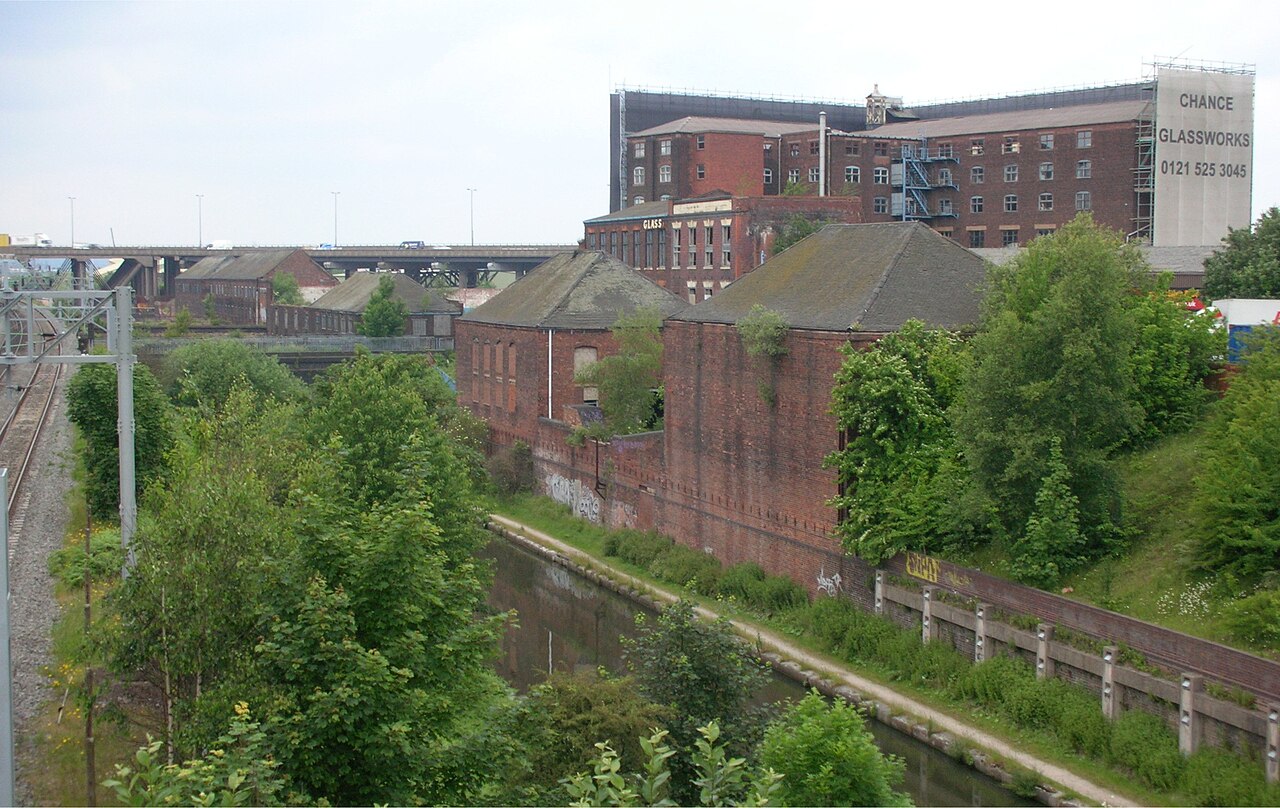
Chance's Glassworks beside the Birmingham Canal New Main Line.
Image credit: Photograph: Oosoom · Source: Wikimedia Commons · CC BY-SA 3.0 · Image date: 13 June 2007
From Smethwick to the Crystal Palace
Chance Brothers supplied glass for the rebuilding of the Houses of Parliament.
But perhaps its most spectacular commission came with the Great Exhibition of 1851.
Joseph Paxton’s enormous Crystal Palace required an extraordinary quantity of glass.
Chance Brothers supplied more than 956,000 square feet for the original building.
When the Crystal Palace was subsequently reconstructed at Sydenham, hundreds of thousands of additional square feet were supplied.
Glass manufactured in Smethwick had become part of one of the defining buildings of the Victorian age.
Lighting the World’s Coastlines
Chance Brothers’ influence travelled even farther through its lighthouse business.
The company developed specialist optical glass and lighthouse lenses and became a major international supplier.
Its equipment was installed in lighthouses around the world.
For generations of sailors, light passing through precision glass manufactured in Smethwick provided a warning of dangerous coastlines and a guide towards safe navigation.
It is one of the most remarkable connections between a Black Country industrial town and global maritime history.
Factories Create Communities
Large factories needed workers.
Workers needed homes.
And growing communities needed shops, schools, churches, pubs, parks and public services.
Industry therefore changed far more than Smethwick’s economy.
It changed the physical town itself.
Housing spread around industrial sites and transport routes. Shopping streets developed. Schools were constructed for growing numbers of children. Public parks provided recreation in an increasingly urban landscape.
The town that emerged during the nineteenth and early twentieth centuries was fundamentally shaped by its factories.
The Industrial Landscape
For generations, industrial buildings were an everyday part of life in Smethwick.
Factory chimneys dominated the skyline.
Canal boats carried materials through the town.
Railways crossed the landscape.
Thousands of residents walked through factory gates every morning.
Even residential streets frequently existed because a nearby works had created demand for housing.
Industry provided livelihoods, but industrialisation also brought smoke, pollution, overcrowding and difficult working conditions.
The industrial history of Smethwick therefore contains both remarkable technological achievements and the everyday experiences of the people whose labour made them possible.
Decline and Redevelopment
During the twentieth century, the industrial economy began changing.
Some companies disappeared. Others merged, relocated or reduced their workforces.
Large factory sites that had dominated neighbourhoods for generations became increasingly vulnerable to closure and redevelopment.
The physical evidence of industrial Smethwick consequently began disappearing.
Chimneys were demolished.
Factories were cleared.
Canal wharves fell out of use.
New roads and housing occupied former industrial land.
Yet important survivors remain.
The historic structures at Soho Foundry are protected, while the surviving Chance Brothers site continues to provide evidence of Smethwick’s glassmaking history.
The canals themselves have survived too.
No longer filled with anything approaching their former level of industrial traffic, they have become an extraordinary linear archive through the town.
Reading Smethwick’s Industrial Past
Walk through Smethwick today and the Industrial Revolution is still visible if you know where to look.
A canal cutting, an old boundary wall, a surviving factory building or an unusually positioned street can reveal how the modern landscape developed.
The history is not confined to museums.
It is embedded in the town itself.
And this is why preserving photographs, maps, documents and people’s memories is so important.
Every surviving piece of evidence helps reconstruct the industrial Smethwick experienced by earlier generations.
Together they tell the story of how canals, steam, glass and engineering transformed a small settlement into one of the most significant industrial communities in the Black Country.