Education in the six towns that now form Sandwell has changed enormously over the last two centuries.
As Smethwick, Oldbury, West Bromwich, Wednesbury, Tipton and Rowley Regis expanded during the Industrial Revolution, growing populations created an increasing demand for places where children could be educated.
Some early schools were connected with churches, chapels, charities or major employers. Later came the imposing Victorian board schools that still survive in parts of the borough, followed by technical schools, grammar schools, secondary moderns and eventually comprehensive education.
The buildings, school records and memories that survive today provide an important record of generations of Black Country childhood.
Education before the school boards
Education existed across the area long before universal state education.
Provision varied considerably. Churches and other religious organisations played an important role, while some industrial employers also became involved in educating workers and their families.
An especially interesting example survives in the records of Chance Brothers.
Black Country History’s catalogue records proposals dating from 1842–1845 for Glass Works Schools associated with the firm’s works at Spon Lane, Smethwick and its alkali works at Oldbury. The surviving documents name Robert Lucas Chance, William Chance and James Timmins Chance.
This is a reminder that education and Sandwell’s industrial development were sometimes closely connected.
The Education Act and the school boards
A major change followed the Elementary Education Act 1870, which allowed locally elected school boards to establish schools where existing provision was insufficient.
The rapidly growing industrial towns of the Black Country were among the places where additional school accommodation was badly needed.
Sandwell Archives now holds records from the school boards of all six Sandwell towns, including material concerning teachers employed in local schools. The archive also preserves admission registers and headteachers’ log books from numerous individual schools.
Those records are particularly valuable because headteachers’ log books can reveal the everyday life of a school rather than merely its official opening and closing dates.
Tipton’s board schools
Tipton provides a particularly clear example of the effect of the 1870 Act.
The Tipton School Board was established in 1871. According to Tipton Civic Society, the schools subsequently erected by the board included:
Great Bridge in 1874, Dudley Port in 1877, Burnt Tree and Tipton Green in 1878, Bloomfield in 1890, Ocker Hill in 1899 and Park Lane in 1903.
This programme demonstrates the scale at which educational provision had to expand as Tipton’s population grew.
The archive record itself survives too. The National Archives records the deposit at Sandwell Community History and Archives Service of material from Park Lane Schools covering 1895–1969.
Wednesbury and Mesty Croft
Wednesbury also developed board-school provision.
A school with a particularly long connection to the town is Mesty Croft. The present school records that the original building was constructed by Wednesbury School Board in February 1880.
It was extended in 1931, before the Victorian building was eventually replaced by a new school in 1981.
Although the buildings changed, the continuation of education on the site illustrates how some Sandwell schools became long-standing institutions within their neighbourhoods.
Victorian schools as landmarks
The school-building programme also left a distinctive architectural legacy.
Large red-brick schools became familiar landmarks within densely populated streets. Their size and architecture reflected the importance increasingly attached to organised education.
Bearwood Primary School in Smethwick is a particularly notable survivor.
Sandwell’s Local List describes it as a large late nineteenth-century school complex. The first school there was built in 1888, with a boys’ school designed by Frank Gill added in 1893. The surviving buildings retain elements of their Victorian Gothic character.
The site has therefore continued serving its original educational purpose for well over a century.
Oldbury and the growth of council education
Development did not follow precisely the same pattern in every town.
A history of Oldbury records that many Victorian schools there originated with churches and that existing provision was sufficient for Oldbury itself not to require a school board. Nearby Warley did establish one, with a board school opening in 1881.
As responsibility increasingly shifted towards local government, council schools were constructed at Rood End, Abbey Road, Rounds Green and Titford Road between 1906 and 1911.
Education was becoming an increasingly visible responsibility of local government.
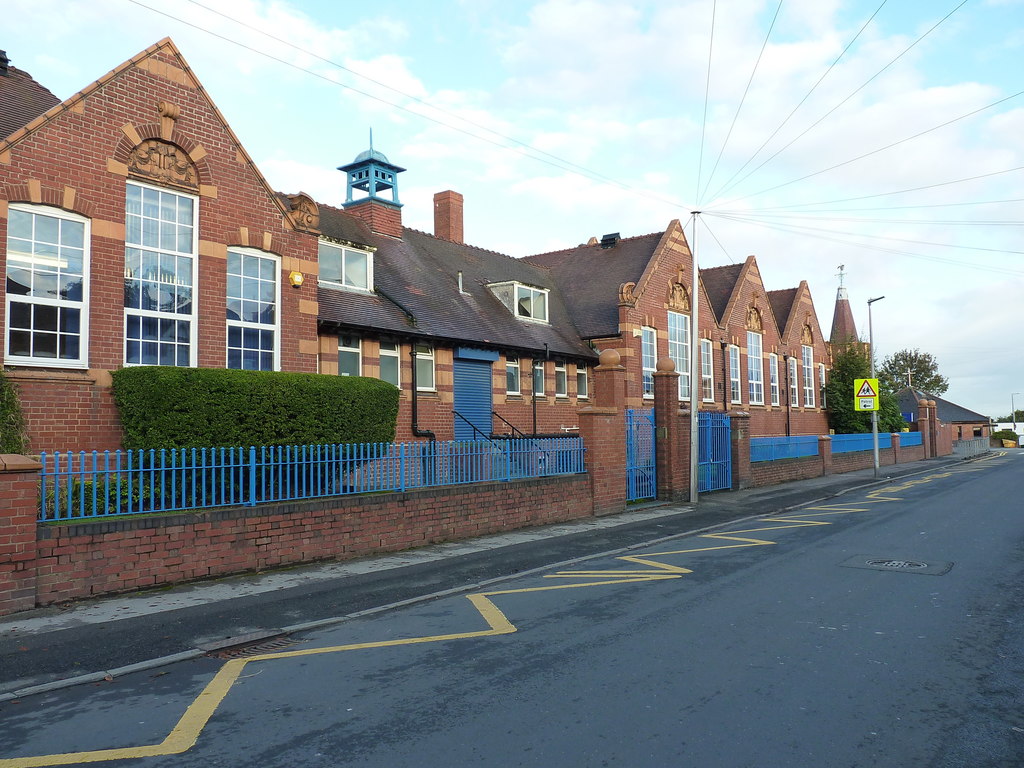
Abbey Junior School, originally part of the Abbey Road Schools built for Oldbury Urban District Council in 1909.
Image credit: Photograph: Richard Law · Source: Geograph Britain and Ireland / Wikimedia Commons · CC BY-SA 2.0 · Image date: 2 October 2019
Technical education for an industrial district
Sandwell’s educational history was not confined to children.
The concentration of engineering and manufacturing created demand for technical knowledge and vocational training.
Smethwick provides one of the best surviving examples.
The former Smethwick Technical School on Crocketts Lane was built in 1908–10 to designs by Frederick J. Gill. Historic England describes its Edwardian Baroque building as surviving largely unaltered, including its richly decorated marble entrance hall and classrooms.
Sandwell’s conservation-area appraisal records that it operated as a Technical School and later became part of the Smethwick campus of Sandwell College.
The building demonstrates the growing importance placed on technical education in an area whose economy depended heavily upon skilled industrial workers.
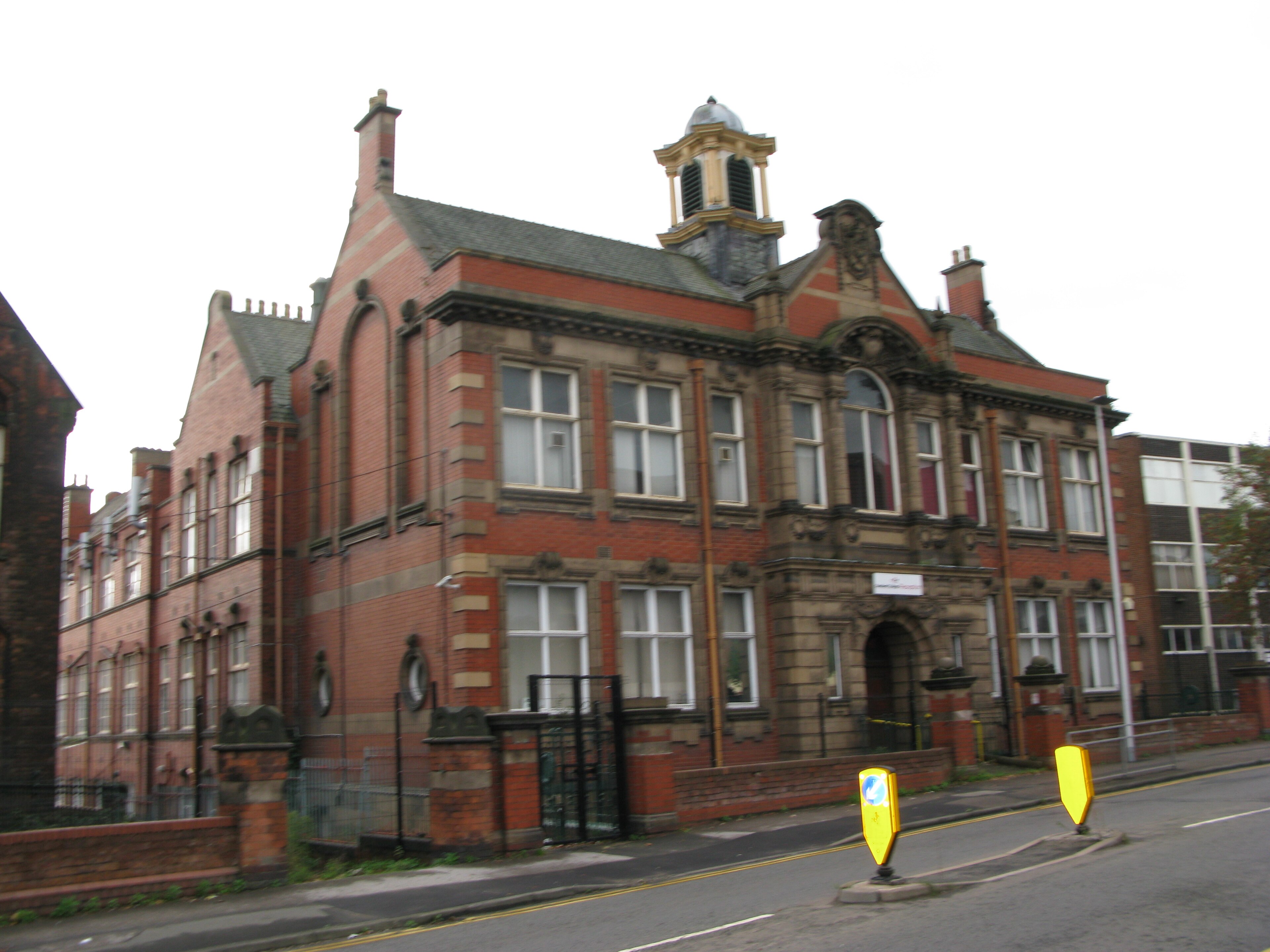
The former Smethwick Technical School on Crocketts Lane, built in 1908–10.
Image credit: Photograph: Brianboru100 · Source: Wikimedia Commons · CC BY-SA 3.0 · Image date: 17 October 2013
Schools after the Second World War
The decades after the Second World War brought another period of major change.
New housing developments required new schools, while older Victorian buildings were increasingly considered unsuitable for modern education.
One example is Annie Lennard School in Smethwick, which opened in 1954 and was named after Annie Elizabeth Lennard, who had served as Mayor of Smethwick in 1952–53. The school itself preserves photographs showing its construction in April 1954.
Across the borough, new primary and secondary schools increasingly became part of the post-war landscape.
Grammar schools, secondary moderns and comprehensive education
For much of the post-war period, children’s secondary education could follow very different paths.
Grammar schools, secondary modern schools and technical education formed parts of the system before comprehensive education became established.
Rowley Regis provides a good illustration of the physical changes associated with this period. A purpose-built Rowley Regis Grammar School opened at Hawes Lane in 1962. The grammar-school era was relatively short-lived, and the site subsequently went through further educational uses before later redevelopment.
These changes reflected a much wider transformation in British secondary education.
The creation of the Metropolitan Borough of Sandwell in 1974 also brought the six towns together under a single local authority.
Schools and changing communities
Schools record social change as well as educational change.
One particularly significant episode occurred at Bearwood Primary School.
Sandwell’s Local List records that Tony O’Connor became headteacher there in 1967, identifying him as Britain’s first Black headteacher. His appointment also attracted racist hostility, including slogans being painted on the school.
The episode places a familiar Smethwick school within a much wider story of immigration, race and social change in post-war Britain.
It also demonstrates why the history of schools cannot be separated from the history of the communities they serve.
What survives in the archives
A remarkable amount of Sandwell’s educational history survives on paper.
Sandwell Archives holds records from numerous schools and colleges, including:
pupil admission registers and headteachers’ log books, together with records from the school boards of the six towns.
Other surviving examples recorded by The National Archives include material from Blackheath Infants School, Britannia Park Nursery School, Rowley Regis Endowed School, The Knowle Infants School and Park Lane Schools in Tipton.
These collections can provide information far beyond the history of school buildings.
Attendance, staff, illnesses, celebrations, disciplinary matters and major local or national events could all find their way into school records.
For family and local historians, they can offer an unusually personal window into everyday life.
More than school buildings
Many former school buildings have disappeared, while others have been extended, converted or completely rebuilt.
Yet schools remain among the most powerful repositories of local memory.
Generations of Sandwell residents remember classrooms, playgrounds, teachers, school dinners, sports days and journeys to school. In some cases, several generations of the same family attended the same establishment.
That makes educational history particularly valuable to a project concerned not only with buildings and dates, but with the experiences of the people who lived here.
An educational landscape still evolving
The history of education across Sandwell is therefore not one single story.
It encompasses Victorian board schools in rapidly expanding industrial districts, church schools, employer-supported education, technical training, grammar schools, post-war rebuilding and the later development of comprehensive education.
Some buildings have vanished.
Others — including surviving Victorian and Edwardian schools — remain familiar landmarks more than a century after pupils first entered their classrooms.
Together with the records preserved by Sandwell Archives and the memories of former pupils, they form an important part of the history of the six towns.
Sources & Further Reading
Sandwell Archives — School Records
Sandwell Archives — Borough Records
Black Country History — Chance Glass Works Schools