West Bromwich has one of the most striking stories of transformation in Sandwell.
Long before the factories, collieries, tramways and busy High Street, this was a much more rural landscape. The settlement appears in the Domesday Book of 1086 as Bromwic, a name generally interpreted as meaning “broom village”, probably referring to the vegetation that grew locally.
The centre of early West Bromwich was also not where most people would recognise the town centre today.
Over centuries, the focus of the settlement moved — and the arrival of industry would eventually transform West Bromwich from a scattered rural community into a major Black Country town.
Medieval West Bromwich
One remarkable survivor provides a physical link with this early history.
Bromwich Hall, traditionally known as the Manor House, has origins in the late thirteenth century. Sandwell Council dates its main medieval hall to around 1270, although the building was enlarged and altered considerably over subsequent centuries. Today it is Grade I listed.
The building is particularly important because so little of medieval West Bromwich survives above ground.
Another important survivor is Oak House, dating principally from the sixteenth century. Together, these buildings remind us that West Bromwich existed for centuries before industrialisation created the urban landscape surrounding them today.
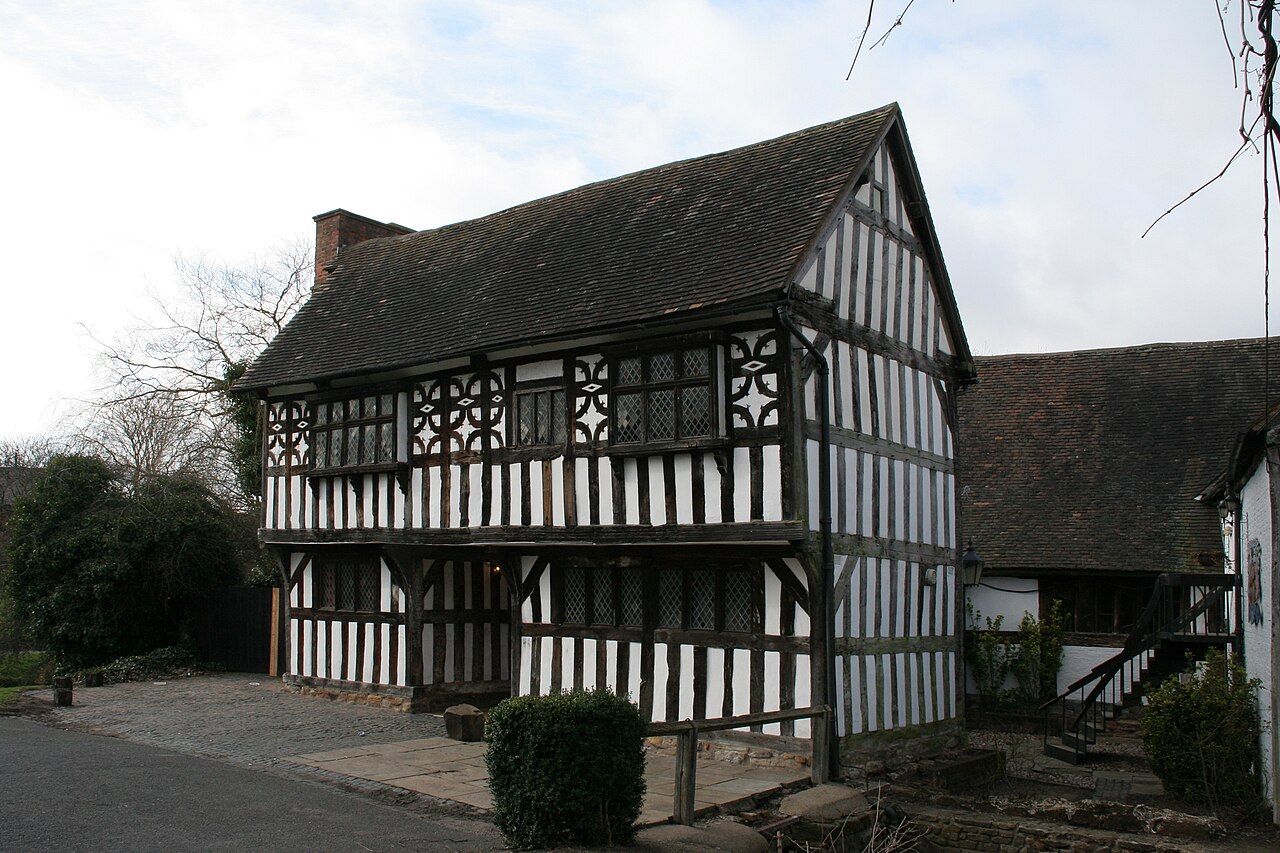
West Bromwich Manor House, whose medieval hall dates from the late thirteenth century.
Image credit: Photograph: Tony Hisgett · Source: Flickr / Wikimedia Commons · CC BY 2.0 · Image date: 25 February 2009
From village to growing town
West Bromwich began changing rapidly during the eighteenth and early nineteenth centuries.
Its location above valuable deposits of coal and ironstone proved crucial. Mining expanded and industries including ironworking, brickmaking, nail making and manufacturing developed alongside it.
The landscape itself also changed.
The enclosure of Bromwich Heath in 1804 helped shift the developing settlement towards the Birmingham–Wolverhampton road. Improvements to that route during the 1820s contributed to the development of the broad High Street that became such a defining feature of West Bromwich.
This is an important part of understanding the modern town.
The historic village had been situated farther north. The West Bromwich town centre familiar to later generations largely developed on what had previously been heathland.
Coal, iron and industry
During the nineteenth century, industrialisation accelerated.
Coal was particularly important. Collieries developed around West Bromwich, supplying the fuel required by furnaces, factories and steam-powered machinery.
Ironworking also expanded, while the availability of marl supported substantial brickmaking.
Manufacturing became increasingly diverse. Springs, guns, nails and other metal products formed part of an economy increasingly associated with the workshops and factories of the Black Country.
Industry attracted workers.
People moved into West Bromwich in search of employment, creating demand for new streets, houses, schools, churches, shops and public services.
The rural settlement was becoming an industrial town.
Canals and railways
Industry depended upon transport.
The canal network allowed heavy materials such as coal, iron and manufactured goods to be moved far more efficiently than was possible using eighteenth-century roads alone.
Railways later added another layer to West Bromwich’s transport infrastructure.
The opening of West Bromwich railway station in 1854 helped accelerate the town’s growth and strengthened connections with Birmingham, Wolverhampton and the wider industrial region.
Road, canal and railway connections therefore worked together to make West Bromwich an increasingly attractive location for industry.
The High Street grows
As West Bromwich expanded, the High Street became the town’s dominant commercial and civic spine.
By 1868, contemporary descriptions presented it as a broad, busy and well-paved thoroughfare. Development of the former Lodge estate and the construction of important municipal buildings reinforced the shift of West Bromwich’s centre towards the High Street.
Eventually the long route between Carters Green and Three Mile Oak became known as the Golden Mile.
Shops, banks, public houses, churches, businesses and public buildings lined the route.
For generations of residents, the High Street was West Bromwich.
Victorian civic ambition
Industrial growth brought considerable wealth to parts of West Bromwich, but it also created serious challenges.
Rapid population growth required better sanitation, roads, public health provision and local administration.
Victorian West Bromwich responded with increasingly ambitious public buildings.
One of the finest survivors is West Bromwich Town Hall, opened in 1875. The Grade II listed building was designed in an Italian Gothic style and remains one of the town’s major landmarks.
The Town Hall and library complex symbolised something important.
West Bromwich was no longer simply an industrial settlement.
It was developing a strong civic identity.
In 1888, West Bromwich became a County Borough, giving the town substantial independence in local government. That status continued until the local-government changes of 1974.
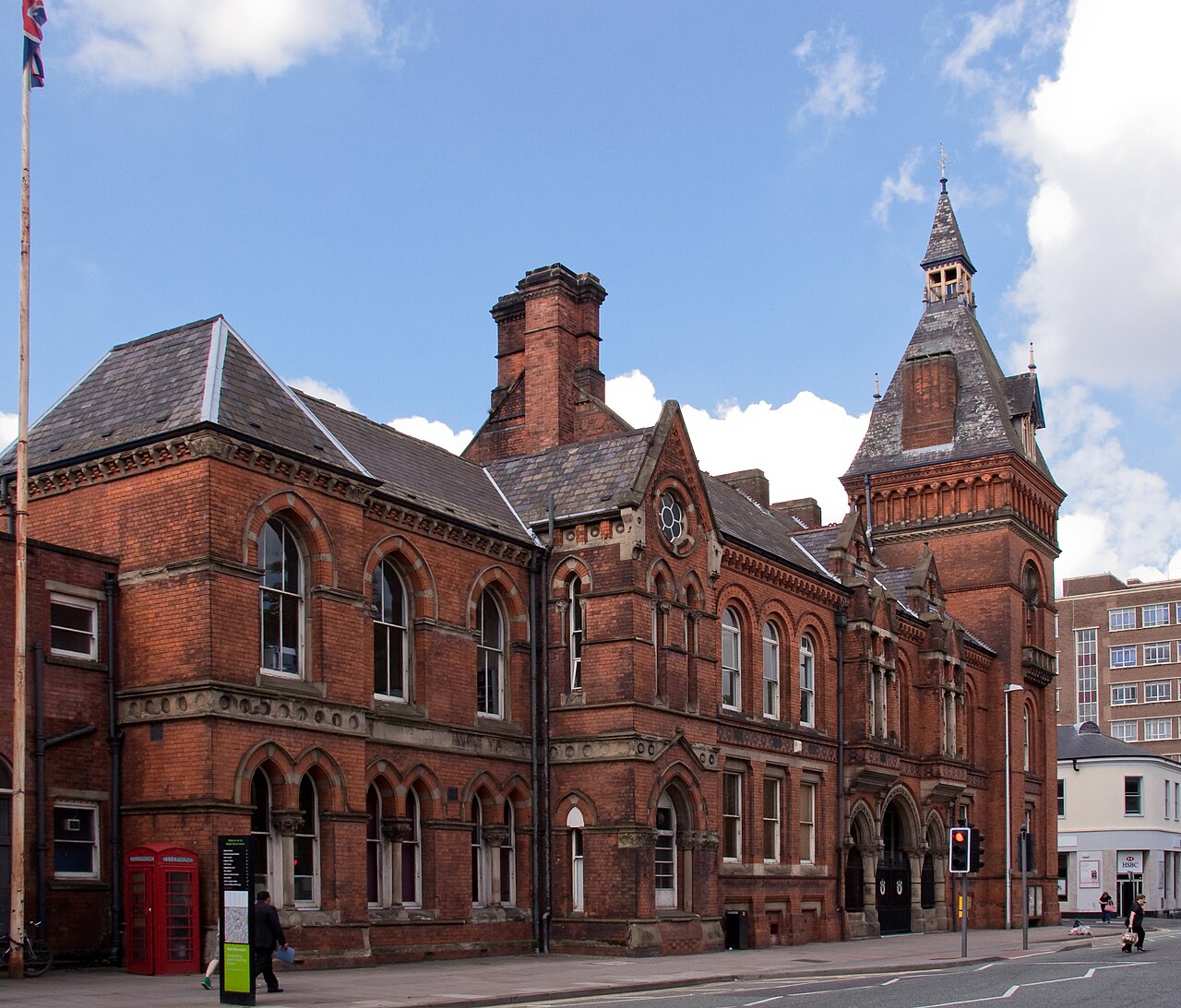
West Bromwich Town Hall, one of the town's most prominent surviving Victorian civic buildings.
Image credit: Photograph: Tony Hisgett · Source: Flickr / Wikimedia Commons · CC BY 2.0 · Image date: 16 June 2009
Parks, museums and public life
Victorian civic development was not confined to administrative buildings.
Public recreation and culture increasingly became part of town life.
One particularly important figure was industrialist and public servant Reuben Farley, who became West Bromwich’s first Mayor and served five terms. His civic interests included improvements to sanitation and street lighting as well as support for institutions that benefited local residents.
Farley donated Oak House and its grounds to the people of West Bromwich. It opened as a museum in 1898 and remains a public heritage site today.
He was also associated with the development of Dartmouth Park and with institutions that became deeply connected with West Bromwich’s identity.
These developments illustrate another side of the industrial town: attempts to create parks, cultural institutions and civic amenities for its growing population.
A football town
Few institutions have carried the name West Bromwich farther around the world than West Bromwich Albion.
The football club became an important part of the town’s identity and remains one of Sandwell’s most internationally recognised names.
Its history also reflects wider social change. During the late 1970s, Albion became famous for regularly fielding three prominent Black players, an important moment in the history of English professional football.
The club’s presence has helped ensure that the name West Bromwich remains familiar far beyond the Black Country.
Twentieth-century expansion
West Bromwich continued expanding during the early twentieth century.
Residential development spread outward and gradually met the growth of neighbouring towns. Former industrial and mining land was increasingly reused for housing, parks, schools and other purposes.
New estates appeared while older districts became increasingly absorbed into the wider Black Country conurbation.
But another major transformation was approaching.
The motor car and changing patterns of shopping presented serious problems for a town centre that had developed largely along one long street.
By the middle of the twentieth century, planners increasingly believed radical redevelopment was necessary.
Rebuilding West Bromwich
The post-war decades changed the centre of West Bromwich dramatically.
Older streets and buildings disappeared as new roads, shopping centres, pedestrian precincts and car parks were constructed.
A ring road and bypass altered traffic patterns, while shopping activity became concentrated within purpose-built developments rather than entirely along the traditional High Street.
Some developments themselves later disappeared or were substantially altered.
The result is that the modern town centre contains layers of several different West Bromwiches: Victorian civic buildings, twentieth-century redevelopment and more recent regeneration.
Yet enough survives to trace the earlier town.
The Town Hall and library remain particularly important landmarks, and recent restoration has sought to preserve both buildings for future generations.
From County Borough to Sandwell
Local government changed dramatically in 1974.
West Bromwich County Borough was abolished and West Bromwich became part of the newly created Metropolitan Borough of Sandwell.
West Bromwich nevertheless remained one of Sandwell’s six principal towns.
Its long-established commercial centre, transport connections, civic buildings and communities ensured that it continued to play a major role within the new borough.
West Bromwich today
Modern West Bromwich is very different from the settlement recorded as Bromwic in 1086.
Medieval buildings survive beside Victorian streets.
Former industrial land has become housing, parks and commercial development.
The High Street has been repeatedly remodelled.
Collieries and ironworks that once dominated parts of the landscape have disappeared almost completely.
But the history remains visible.
Bromwich Hall and Oak House preserve connections with the pre-industrial settlement.
The High Street records the town’s nineteenth-century expansion.
The Town Hall represents Victorian civic confidence.
Canals, railway infrastructure and surviving industrial buildings reveal the economy that created modern West Bromwich.
And beneath areas of housing and parkland lie landscapes once occupied by collieries and industry.
West Bromwich is therefore not simply a town that grew during the Industrial Revolution.
It is a place that has moved, expanded and reinvented its centre repeatedly over almost a thousand years — from medieval Bromwic, through the Black Country’s industrial age, to the modern West Bromwich of today.