Oldbury was not always the densely developed Black Country town we recognise today.
In the seventeenth century it was still a small country settlement, home to smallholders and nail makers. Fields and open land surrounded the community, and the enormous industrial landscape that would eventually dominate Oldbury had yet to appear.
During the late eighteenth and nineteenth centuries, however, Oldbury underwent an extraordinary transformation.
Beneath the surrounding countryside lay valuable deposits of coal and ironstone. Once improved transport made those resources easier to exploit, mines, furnaces, factories and workshops spread across Oldbury and neighbouring Langley.
Within generations, the rural landscape had become one of the industrial centres of the Black Country.
The canals unlock Oldbury
Transport was fundamental to Oldbury’s industrial development.
The road through Oldbury was turnpiked around 1760, but an even more significant change followed with the arrival of the canal in 1772. James Brindley’s canal connected the Black Country coalfield with Birmingham and provided a practical way of transporting heavy materials in quantities that roads of the period could not easily accommodate.
The canal network continued to expand.
In 1837 the Titford Canal opened, serving coal mines around the Rowley Hills and further strengthening Oldbury’s connection with the wider Birmingham Canal Navigations.
Coal, iron, bricks, chemicals and manufactured goods could now move between industrial works, wharves and distant markets.
Oldbury’s waterways were therefore far more than landscape features. They were working arteries around which industry developed.
Coal beneath Oldbury
Coal mining became one of the forces that fundamentally reshaped the town.
Although coal and ironstone had been extracted locally for centuries, mining expanded dramatically from the end of the eighteenth century as canals improved access to markets and technology made deeper seams exploitable.
The Oldbury coalfield reached its peak around 1860.
Collieries and associated industries spread across the area, while coal supplied furnaces, factories and countless steam engines.
Ironworking developed alongside mining. Four blast furnaces are recorded as operating in the Oldbury district between approximately the 1780s and 1860s.
Mining was dangerous work, and industrial expansion left enormous physical scars.
Spoil heaps, pits, marl holes and quarries replaced areas that had previously been countryside. Pollution from furnaces and factories added another layer to Oldbury’s changing landscape.
Coal mining declined rapidly after about 1870 as workings became exhausted or flooded. Most collieries had disappeared by 1900, although some briefly reopened during the First World War. Mining in Oldbury had effectively ended by 1925.
But by then, coal had helped create something much larger.
Oldbury had become an industrial town.
Chemicals change the landscape
One industry became particularly important to Oldbury: chemicals.
Chemical manufacture was established locally during the 1830s when Chance Brothers developed alkali production to supply its famous glassworks in neighbouring Smethwick.
A further milestone came around 1850, when phosphorus manufacture began in Oldbury.
Arthur Albright had pioneered commercial phosphorus manufacture in Birmingham before entering partnership with John Edward Wilson. Their enterprise developed into Albright & Wilson, whose Oldbury works became one of the area’s best-known industrial sites.
The company became particularly associated with phosphorus and phosphorus compounds. These materials had applications ranging from match manufacture to numerous industrial chemical processes.
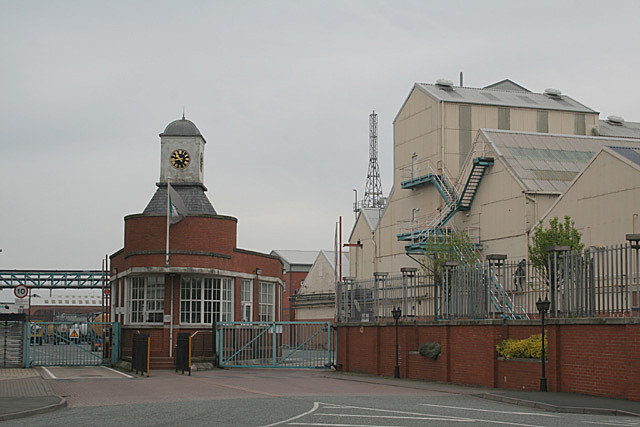
The entrance to the former Albright & Wilson chemical works at Langley Green, Oldbury, photographed in 2007.
Image credit: Photograph: Alan Murray-Rust · Source: Geograph Britain and Ireland / Wikimedia Commons · CC BY-SA 2.0 · Image date: 22 April 2007
More than coal and chemicals
Oldbury’s industrial economy was remarkably diverse.
As coal mining declined, brickmaking expanded using local deposits of Etruria marl. Metalworking continued through foundries and firms manufacturing tools, boilers, tubes and other engineering products.
The Oldbury Railway Carriage and Wagon Works, established in 1854, became another major local enterprise.
Other companies added to the industrial mixture.
Edwin Danks established a business manufacturing canal boats and boilers in 1868. Ham Baker developed municipal engineering works at Langley, while Accles & Pollock established tube manufacturing in Oldbury in 1902.
Oldbury was becoming a place where mining, chemicals, metals, transport equipment and engineering existed side by side.
Railways and industrial transport
Canals had opened Oldbury to industrial development, but railways provided another important transport network.
The railway reached the area in the nineteenth century, with Oldbury and Bromford Lane station opening in 1852 on the Stour Valley route.
Railways allowed workers and goods to move rapidly between Oldbury and the growing industrial centres surrounding it.
Langley Green became an important part of this network. A short branch also ran from the main railway towards Oldbury itself, providing a direct connection into the industrial town.
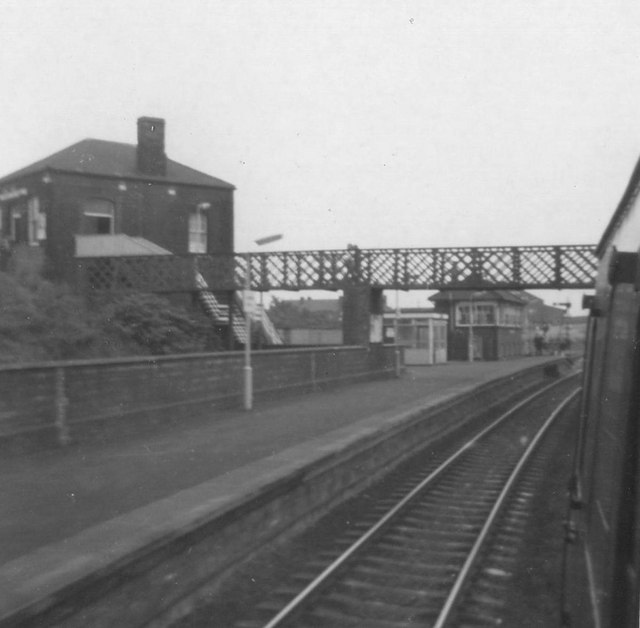
Langley Green Station in July 1975. Beyond the signal box was once the short branch railway that ran beneath Western Road towards Oldbury town.
Image credit: Photograph: Michael Westley · Source: Geograph Britain and Ireland / Wikimedia Commons · CC BY-SA 2.0 · Image date: July 1975
Industry creates a town
Factories needed workers.
As employment expanded, people moved into Oldbury and Langley and the population increased rapidly.
Housing had to be built quickly. Much of it was modest accommodation constructed close to places of employment, and overcrowding and poor sanitation became serious problems.
Gradually the infrastructure of an established urban community appeared.
Churches, schools, shops and public buildings were constructed. Water supplies and sewerage improved. Public parks provided much-needed open space in a landscape increasingly dominated by housing and industry.
Local government developed alongside the town. Public buildings and a library opened in Market Place in 1891, and in 1894 Oldbury became an Urban District covering Oldbury, Langley and Warley.
Industrialisation had therefore changed far more than Oldbury’s economy.
It had created the physical town itself.
Oldbury at war
Oldbury’s industrial capacity became nationally important during the two world wars.
One of the most remarkable examples was the Oldbury Carriage Works.
During the First World War, railway-carriage production was adapted for military purposes and the works became heavily involved in manufacturing tanks. Recent Sandwell historical research records that the works manufactured the first 1,000 tanks, drawing components from other Black Country factories, and later produced more than 2,000 tanks for the final campaigns of 1918.
Oldbury’s chemical works were equally significant.
Albright & Wilson produced phosphorus-based materials for wartime use, while the former Chance chemical operation was involved in explosives manufacture.
For local families, however, wartime industry also meant long hours, dangerous work and the knowledge that Oldbury’s factories were contributing directly to Britain’s war effort.
The industrial landscape disappears
By the middle of the twentieth century, Oldbury had been shaped by industry for generations.
But the industries themselves would not last forever.
Coal mining had already disappeared. During the decades after the Second World War, many traditional Black Country industries declined, closed or consolidated.
Industrial land presented another problem.
More than a century of mining, quarrying and manufacturing had left contaminated and derelict sites across the area. Reclaiming this land became one of the defining challenges of twentieth-century Oldbury.
Factories disappeared.
Pits and marl holes were filled.
Roads changed.
Housing estates, commercial developments and new public buildings occupied land that previous generations would have known as mines, works or open industrial ground.
Yet traces of industrial Oldbury remain.
Canals still cross the landscape. Surviving factory buildings, bridges, railway structures and street patterns reveal fragments of the town that once existed.
The industry beneath modern Oldbury
Modern Oldbury cannot really be understood without its industrial past.
Coal brought mines.
Mines encouraged ironworking.
Canals connected Oldbury with Birmingham and the wider Black Country.
Chemical companies and engineering firms created employment on an enormous scale.
Railways added another transport network.
And the workers those industries attracted created the streets, neighbourhoods and communities from which modern Oldbury developed.
Much of that industrial landscape has now disappeared.
But its influence remains embedded in the town.
Every surviving canal cutting, former factory wall, railway bridge and reclaimed industrial site is part of the story of how a small rural Black Country settlement became industrial Oldbury.